
Only 30% of small businesses consistently track the return on their marketing spend, meaning the majority are essentially flying blind with money they can’t afford to waste [1]. For any business operating on a tight budget, that gap between spending and knowing is not just inefficient; it’s dangerous. Understanding small business marketing ROI is the difference between scaling a business confidently and guessing your way through every quarter.
This guide breaks down what good ROI looks like across every major marketing channel, how to measure it accurately, and which strategies deliver the strongest returns for small and mid-sized businesses in 2026.
Key Takeaways
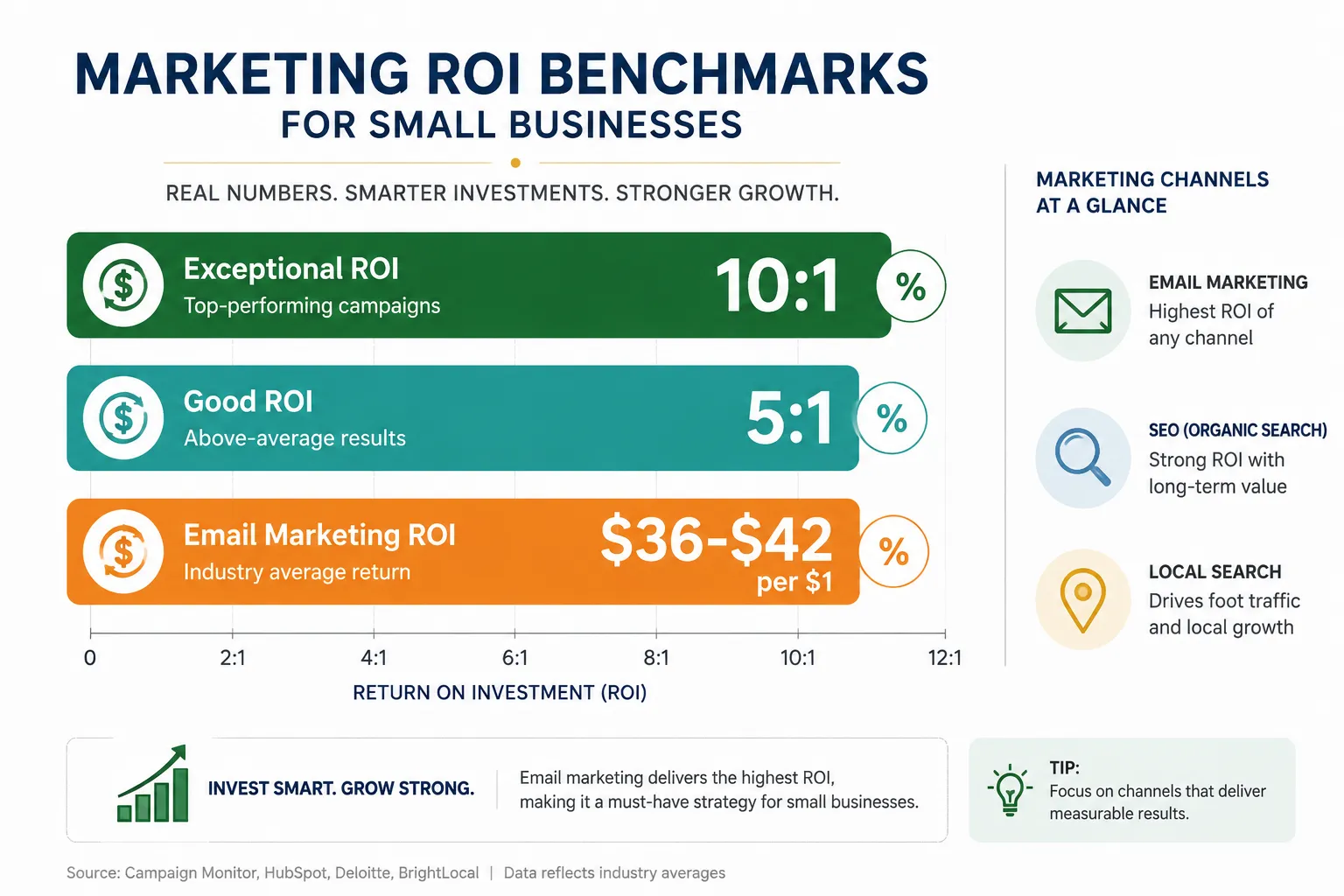
- A 5:1 ratio is the widely accepted benchmark for good digital marketing ROI, with 10:1 considered exceptional for small businesses [3]
- Email marketing consistently delivers the highest ROI of any channel, often cited at $36 to $42 returned for every $1 spent [6]
- SEO and local search produce compounding, long-term returns that grow over time without proportional cost increases
- Paid search and paid social offer fast, scalable results but require active budget management to maintain profitability
- Measurement is the single biggest gap in small business marketing, businesses that track ROI consistently outperform those that do not
What Is Small Business Marketing ROI and Why Does It Matter
Marketing ROI, return on investment, measures how much revenue a business generates for every dollar it spends on marketing. The basic formula is straightforward:
Marketing ROI = (Revenue from Marketing – Marketing Cost) / Marketing Cost x 100
For example, if a small business spends $1,000 on a campaign and generates $5,000 in attributed revenue, the ROI is 400%.
But for small businesses, ROI is more than a math exercise. It is the primary tool for deciding where limited budgets go, which channels to scale, and which to cut. Unlike large enterprises that can absorb underperforming campaigns, small businesses operate with thinner margins and smaller reserves. Every marketing dollar needs to justify itself.
What Counts as a “Good” ROI for Small Businesses
Digital marketing overall averages roughly a 5:1 ROI, meaning $5 returned for every $1 spent, across industries and business sizes [3]. That ratio is widely treated as the baseline benchmark for acceptable performance. A 10:1 ratio is considered exceptional and is achievable in high-margin industries or with highly optimized campaigns.
Anything below 2:1 is generally unprofitable once overhead and operational costs are factored in. A ratio between 2:1 and 5:1 is considered adequate but suggests room for significant improvement.
“The goal is not just to spend less on marketing, it is to spend smarter, track rigorously, and reinvest in what works.”
It is worth noting that “good” ROI is relative to industry, margin structure, and business model. A service business with 70% margins can tolerate a lower revenue-to-spend ratio than a product business with 20% margins. Always calculate ROI against net margin, not gross revenue, for the most accurate picture.
The Measurement Gap Among Small Businesses
Despite how critical ROI tracking is, measurement remains the weakest link in small business marketing. Research shows that a significant share of small businesses either do not track marketing performance at all or rely on anecdotal evidence rather than data [1]. This is not a technology problem, free tools like Google Analytics 4, Google Search Console, and platform-native dashboards make basic tracking accessible to any business. It is primarily a habits and systems problem.
Businesses that establish even basic tracking, UTM parameters, conversion goals, and channel-level attribution, immediately gain a competitive edge over the majority of their peers who are not measuring at all [9].
Channel-by-Channel ROI Benchmarks for Small Businesses
Not all marketing channels are created equal. Each has a different cost structure, time horizon, and typical return profile. Understanding these differences helps small businesses allocate budgets more intelligently.

Email Marketing: The Highest-ROI Channel in 2026
Email marketing continues to outperform every other channel on a pure ROI basis. Industry data consistently shows returns in the range of $36 to $42 for every $1 spent, making it the most cost-efficient channel available to small businesses [6]. Some estimates place the figure even higher depending on list quality and industry.
Why does email perform so well? Several structural advantages explain it:
- Low cost per send. Most email platforms charge based on list size, not send volume, keeping marginal costs extremely low.
- Owned audience. Unlike social media followers, an email list is an asset the business owns. Algorithm changes do not reduce its reach.
- High purchase intent. Subscribers have already opted in, signaling interest. Conversion rates on email campaigns consistently outperform cold traffic from ads.
- Automation potential. Welcome sequences, abandoned cart emails, and re-engagement flows generate revenue with minimal ongoing effort.
For small businesses not yet investing in email marketing, it represents the single highest-impact starting point. For those already using it, list segmentation and behavioral automation are the primary levers for increasing returns further [6].
Email ROI Quick Reference:
| Metric | Benchmark |
|---|---|
| Average ROI | $36-$42 per $1 spent |
| Average open rate (SMB) | 20-30% |
| Average click-through rate | 2-5% |
| Best use case | Retention, upsell, nurture |
SEO and Local Search: Compounding Returns Over Time
Search engine optimization delivers a fundamentally different ROI profile than paid channels. The returns are slower to materialize, typically three to six months before meaningful organic traffic arrives, but they compound over time in a way paid traffic does not.
Once a page ranks well for a target keyword, it continues generating traffic without additional spend. That means the cost-per-visitor decreases month over month, and ROI improves continuously as long as rankings hold. For small businesses in competitive local markets, this compounding effect is particularly powerful.
Local SEO, optimizing for “near me” searches, Google Business Profile, and local directory listings, is especially high-value for brick-and-mortar businesses. Research shows that 76% of people who search for something nearby on their smartphone visit a related business within one day [2]. That conversion speed is difficult to match with any other channel.
Key SEO tactics with strong ROI for small businesses include:
- Google Business Profile optimization, free to set up, high impact on local visibility
- On-page SEO, title tags, meta descriptions, and content structured around target keywords
- Local citations, consistent NAP (name, address, phone) listings across directories
- Review generation, positive reviews improve both rankings and conversion rates
- Content marketing, blog posts and guides that answer customer questions and capture long-tail search traffic
The primary cost of SEO is time or the fee paid to an agency or freelancer. For businesses that invest consistently, organic search typically reaches a positive ROI within six to twelve months and continues improving thereafter [7].
Paid Search (PPC): Fast, Scalable, and Measurable
Pay-per-click advertising through Google Ads or Microsoft Advertising delivers results immediately, traffic begins the moment a campaign goes live. This makes it valuable for new businesses that cannot wait for SEO to mature, for seasonal promotions, and for testing new offers before committing to organic content creation.
The average ROI for Google Ads across industries is roughly 200%, a 2:1 return, though this varies significantly by industry, keyword competition, and campaign quality [3]. Highly optimized campaigns in lower-competition niches can achieve 5:1 or better. Poorly managed campaigns in competitive markets can easily run at a loss.
The key variables that determine paid search ROI are:
- Quality Score, Google’s rating of ad relevance, which directly affects cost-per-click
- Landing page conversion rate, traffic is worthless if the page does not convert
- Customer lifetime value (CLV), high-CLV businesses can afford higher acquisition costs
- Keyword intent, bottom-of-funnel, transactional keywords convert far better than informational ones
For small businesses, the most common mistake in paid search is treating it as a set-and-forget channel. Active management, pausing underperforming keywords, testing ad copy, refining audience targeting, is what separates profitable campaigns from money-losing ones.
Paid Social Media: Moderate ROI with Strong Targeting
Paid social advertising on platforms like Meta (Facebook and Instagram), TikTok, and LinkedIn offers granular audience targeting that is unmatched by search advertising. Businesses can reach people based on demographics, interests, behaviors, and lookalike audiences built from existing customers.
However, paid social typically delivers lower direct ROI than email or SEO, primarily because the audience is not actively searching for what the business offers. Social ads interrupt; search ads intercept intent. That distinction matters for conversion rates.
The average ROI for social media advertising for small businesses sits in the 2:1 to 4:1 range, though this varies considerably by platform, creative quality, and offer [8]. Social media tends to perform best as a top-of-funnel awareness and retargeting tool rather than a direct-response channel.
Where paid social genuinely excels for small businesses:
- Retargeting website visitors, people who have already shown interest convert at much higher rates
- Lookalike audiences, targeting people who resemble existing customers
- Visual product businesses, e-commerce, food, fashion, and home decor perform particularly well on Instagram and TikTok
- Local awareness campaigns, geotargeted ads for brick-and-mortar businesses
Organic Social Media: Lower Direct ROI, High Brand Value
Organic social media, posting without paid promotion, has seen significant reach declines across most platforms as algorithms favor paid content. The direct, attributable ROI of organic social is difficult to measure and generally lower than other channels.
That said, organic social serves important functions: brand awareness, community building, customer service, and social proof. For businesses in visually driven industries or with strong community followings, it can drive meaningful traffic and conversions. The key is not to over-invest in organic social at the expense of higher-ROI channels.
How to Build a Small Business Marketing Budget That Maximizes ROI
Budget allocation is where strategy becomes real. The right channel mix depends on business stage, industry, and goals, but research on SMB marketing budgets in 2026 provides useful benchmarks [4].

What Small Businesses Are Spending on Marketing
The U.S. Small Business Administration recommends allocating 7-8% of gross revenue to marketing for businesses with revenues under $5 million and healthy margins. Businesses in highly competitive markets or in growth phases often spend 10-12% [4].
In 2026, the channel mix for SMB marketing budgets skews heavily toward digital:
- Digital advertising (paid search + paid social): 35-45% of budgets
- Content and SEO: 20-25%
- Email marketing: 10-15%
- Social media management: 10-15%
- Traditional/offline marketing: 10-15%
These are averages, and the right mix for any individual business depends on where its customers are, what stage the business is in, and what has worked historically.
The “Test, Measure, Scale” Framework
The most effective approach to small business marketing ROI is not to guess at the optimal channel mix from the start. It is to test small, measure rigorously, and scale what works.
Step 1: Set a baseline budget. Allocate a small portion of the marketing budget, 10-20%, to testing new channels or tactics.
Step 2: Define success metrics upfront. Before launching any campaign, decide what a successful result looks like. Is it cost per lead? Cost per acquisition? Revenue generated? Without predefined metrics, measurement becomes subjective.
Step 3: Run for long enough to get meaningful data. Most campaigns need at least 30 days and a statistically meaningful number of conversions before drawing conclusions. Cutting campaigns too early based on insufficient data is a common and costly mistake.
Step 4: Compare results against benchmarks. Use industry benchmarks as a reference point, not an absolute standard. What matters most is whether the channel is profitable for the specific business.
Step 5: Scale winners, cut losers. Redirect budget from underperforming channels to those demonstrating strong ROI. Repeat the cycle quarterly.
Prioritizing Channels by Business Stage
Different stages of business growth call for different channel priorities:
Early stage (0-2 years): – Google Business Profile and local SEO (free, high impact) – Email list building from day one – Paid search for immediate traffic and lead generation – Organic social for brand awareness
Growth stage (2-5 years): – Scale paid search with proven offers – Invest in content marketing and SEO for long-term compounding – Add paid social for retargeting and lookalike audiences – Deepen email automation sequences
Established stage (5+ years): – Diversify across all high-performing channels – Invest in brand-building alongside performance marketing – Explore partnerships, affiliates, and referral programs – Focus on customer lifetime value and retention marketing
Measuring Small Business Marketing ROI Accurately
Knowing which channels to invest in is only half the equation. The other half is measuring ROI accurately enough to make confident decisions. This is where many small businesses struggle most [5].
Setting Up Basic Tracking Infrastructure
Accurate ROI measurement requires a minimum viable tracking stack. For most small businesses, this includes:
- Google Analytics 4 (GA4), tracks website traffic, user behavior, and conversion events
- Google Search Console, monitors organic search performance and keyword rankings
- UTM parameters, URL tags that identify the source, medium, and campaign for every link shared in emails, ads, or social posts
- Platform-native analytics, Google Ads, Meta Ads Manager, and email platforms all provide channel-level performance data
- A CRM or lead tracking system, connects marketing activity to actual sales outcomes
Without these tools in place, any ROI calculation is an estimate at best and a fiction at worst.
Attribution: The Hardest Part of ROI Measurement
Attribution, determining which marketing touchpoint deserves credit for a sale, is genuinely complex, especially for businesses with longer sales cycles or multiple customer touchpoints. A customer might discover a business through a Google search, follow it on Instagram, receive an email, and then click a retargeting ad before finally purchasing. Which channel gets credit?
Common attribution models include:
- Last-click attribution, 100% credit to the final touchpoint before purchase. Simple but often misleads by undervaluing awareness channels.
- First-click attribution, 100% credit to the first touchpoint. Useful for understanding how customers discover the business.
- Linear attribution, equal credit distributed across all touchpoints. More balanced but harder to act on.
- Data-driven attribution, uses machine learning to assign fractional credit based on actual conversion paths. Most accurate but requires significant data volume.
For most small businesses, a combination of last-click attribution for direct response campaigns and first-click for awareness campaigns provides a practical and actionable starting point.
Key Metrics to Track by Channel
Email marketing: – Open rate, click-through rate, conversion rate – Revenue per email sent – List growth rate and unsubscribe rate
SEO: – Organic sessions, keyword rankings – Organic conversion rate – Cost per organic lead (agency/tool cost divided by leads generated)
Paid search: – Cost per click (CPC), click-through rate – Conversion rate, cost per acquisition (CPA) – Return on ad spend (ROAS)
Paid social: – Cost per thousand impressions (CPM), click-through rate – Cost per lead or cost per purchase – Frequency (to avoid ad fatigue)
Overall business: – Customer acquisition cost (CAC) – Customer lifetime value (CLV) – CLV:CAC ratio (target 3:1 or higher for sustainable growth)
Common ROI Measurement Mistakes to Avoid
Measuring too soon. SEO and content marketing take months to show results. Evaluating them on a 30-day timeline leads to premature cuts of strategies that would have paid off.
Ignoring offline conversions. Phone calls, in-store visits, and word-of-mouth referrals driven by digital marketing often go unmeasured. Call tracking software and customer surveys can capture some of this data.
Confusing revenue with profit. A campaign that generates $10,000 in revenue with $8,000 in product costs and $3,000 in ad spend is actually unprofitable. Always calculate ROI against margin, not top-line revenue.
Siloing channel data. Viewing each channel in isolation misses the cross-channel effects that drive actual customer journeys. Use a unified dashboard or analytics platform to see the full picture.
Strategies to Improve Small Business Marketing ROI in 2026
With benchmarks established and measurement systems in place, the focus shifts to actively improving returns. The following strategies are consistently cited as the highest-impact levers for small business marketing ROI [7] [9].
Optimize for Customer Lifetime Value, Not Just Acquisition
The most reliable way to improve marketing ROI is to increase how much each customer is worth over time. A business that generates $500 in lifetime value from a customer can afford to spend significantly more to acquire that customer than a competitor generating $150.
Tactics that increase CLV: – Loyalty programs and repeat purchase incentives – Upsell and cross-sell sequences in email automation – Subscription or retainer models that create recurring revenue – Exceptional post-purchase experience that drives referrals
Invest in Conversion Rate Optimization (CRO)
Doubling the conversion rate of a landing page effectively doubles the ROI of every traffic source feeding into it, without increasing ad spend. CRO is one of the highest-leverage activities available to small businesses.
Basic CRO tactics with strong impact: – Clear, benefit-focused headlines on landing pages – Prominent and specific calls to action – Social proof (reviews, testimonials, case studies) near conversion points – Simplified forms, fewer fields consistently improve form completion rates – Mobile optimization, more than 60% of web traffic now comes from mobile devices [2]
Leverage Marketing Automation
Marketing automation allows small businesses to deliver personalized, timely communications at scale without proportional increases in labor cost. Automated email sequences, welcome series, abandoned cart recovery, post-purchase follow-up, run continuously and generate revenue around the clock [6].
Beyond email, automation can include: – SMS follow-ups for high-intent leads – Retargeting ad sequences triggered by website behavior – CRM-based lead nurturing workflows – Automated review request campaigns
Focus Budget on Proven Channels Before Experimenting
A common mistake is spreading budget too thin across too many channels simultaneously. The most effective approach for small businesses with limited budgets is to achieve strong performance on one or two channels before expanding. Depth before breadth.
Once a channel is profitable and optimized, the incremental investment needed to scale it is far lower than the investment required to launch and optimize a new channel from scratch.
Use Competitive Intelligence to Find Gaps
Understanding what competitors are doing, and more importantly, what they are not doing, can reveal high-value opportunities. Tools like Google’s Keyword Planner, SEMrush, and Ahrefs (at various price points) show which keywords competitors rank for, what their ad copy looks like, and where gaps in the market exist.
Local businesses can also monitor competitor Google Business Profiles, review volumes, and response rates to identify areas where they can differentiate and capture market share.
Frequently Asked Questions About Small Business Marketing ROI
What is a realistic marketing ROI for a small business just starting out?
In the first six to twelve months, many small businesses will see ROI below the 5:1 benchmark as they test channels, build audiences, and optimize campaigns. A realistic early target is breaking even (1:1) on paid channels while building organic assets like email lists and SEO that will compound over time. Patience and consistent measurement are essential during this phase [3].
How much should a small business spend on marketing to see meaningful ROI?
There is no universal minimum, but research suggests that budgets below 2-3% of revenue rarely generate enough activity to produce measurable results. The SBA recommends 7-8% for most small businesses. The more important factor is consistency, sustained investment over time outperforms sporadic large spending [4].
Which marketing channel has the best ROI for small businesses?
Email marketing consistently delivers the highest ROI on a per-dollar-spent basis, with returns of $36 to $42 per $1 invested being commonly cited [6]. However, the best channel for any specific business depends on where its customers are, the nature of the product or service, and the business’s ability to execute on each channel effectively.
How long does it take to see ROI from SEO?
Most small businesses begin seeing meaningful organic traffic improvements within three to six months of consistent SEO effort. Significant ROI, where organic search becomes a primary revenue driver, typically takes six to twelve months. The payoff is that once rankings are established, the cost per visitor continues to decrease over time [7].
How do small businesses measure marketing ROI without a large analytics team?
The minimum viable setup is Google Analytics 4 for website tracking, UTM parameters on all external links, and conversion goals configured for key actions (form submissions, purchases, phone calls). Most email and ad platforms provide built-in ROI reporting. A single person can manage this effectively with a few hours of setup and regular monthly review [9].
What is the biggest mistake small businesses make with marketing ROI?
The most common and costly mistake is not measuring at all, or measuring the wrong things. Tracking vanity metrics like social media followers or page views without connecting them to revenue gives a false sense of progress. Every marketing activity should be tied to a business outcome: leads generated, sales made, or revenue attributed [5].
Conclusion
Small business marketing ROI is not a complex concept, but it does require discipline, systems, and a willingness to follow the data rather than intuition. The businesses that consistently outperform their competitors on marketing efficiency share a few common traits: they measure everything, they prioritize high-ROI channels like email and SEO, they optimize for customer lifetime value, and they reinvest in what works.
Actionable next steps for small businesses in 2026:
- Audit current tracking. Confirm that Google Analytics 4 is installed, conversion goals are configured, and UTM parameters are being used on all campaigns. Fix gaps before spending another dollar on marketing.
- Calculate current ROI by channel. Pull data from the last 90 days across every active marketing channel. Identify which channels are profitable and which are not.
- Start or optimize an email list. If email marketing is not already a priority, make it one. The ROI data is unambiguous. If it is already in use, add at least one automated sequence, a welcome series or abandoned cart flow, to increase returns without increasing send volume.
- Claim and optimize Google Business Profile. For any business serving a local market, this is the single highest-leverage free action available.
- Set a 90-day ROI target for every active channel. Define what success looks like, measure against it, and make budget decisions based on results rather than assumptions.
- Reinvest in proven channels before testing new ones. Resist the temptation to chase new platforms or tactics until current channels are fully optimized.
Marketing is not a cost center, it is the engine of business growth. Treat it with the same rigor applied to operations, finance, and product development, and the returns will follow.
References
[1] Small Business Marketing Statistics – https://biziq.com/blog/small-business-marketing-statistics/
[2] Small Business Marketing Statistics – https://ppcchief.com/small-business-marketing-statistics
[3] Whats A Good Roi For Digital Marketing In 2026 – https://www.diamond-group.co/blog/whats-a-good-roi-for-digital-marketing-in-2026
[4] Smb Marketing Budget Statistics 2026 – https://stealthagents.com/research/smb-marketing-budget-statistics-2026
[5] Marketing Statistics For Small Business – https://www.revenuememo.com/p/marketing-statistics-for-small-business
[6] Why Email Still Delivers The Highest Roi In 2026 And How To Max It – https://www.wsiworld.com/blog/why-email-still-delivers-the-highest-roi-in-2026-and-how-to-max-it
[7] Small Business Marketing 2026 Roi Strategies – https://marketleaderbiz.com/small-business-marketing-2026-roi-strategies/
[8] Small Business Marketing Statistics 2025 Trends Benchmarks Insights – https://vicarcreative.com/blog/small-business-marketing-statistics-2025-trends-benchmarks-insights
[9] Small Business Marketing Roi – https://ivanvislavskiy.com/blog/small-business-marketing-roi
[10] Marketing Roi Blueprint 2025 – https://www.nielsen.com/insights/2025/marketing-roi-blueprint-2025/