

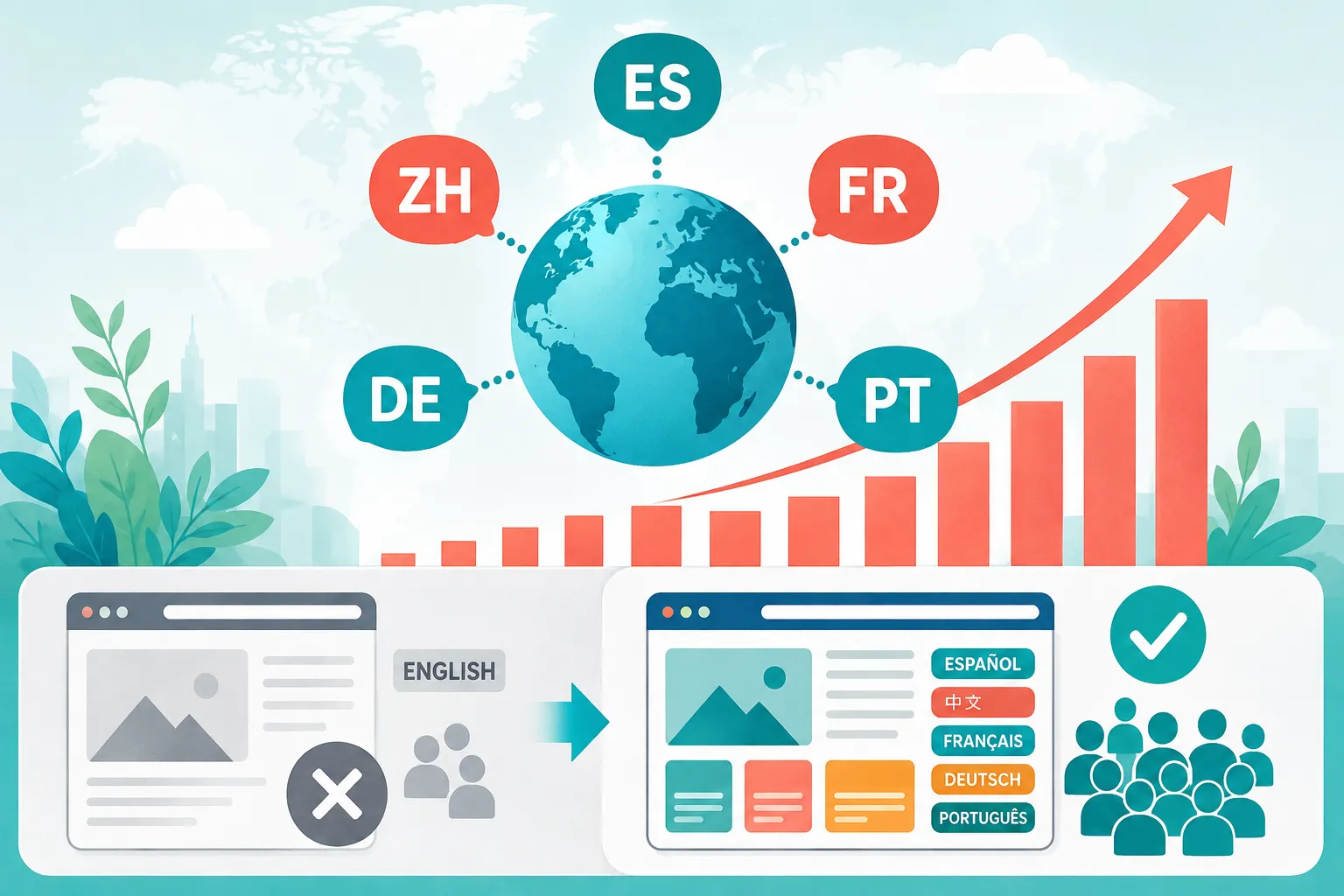
Seventy-six percent of online shoppers prefer to buy when product information appears in their native language, and 40% say they will never purchase from a site written in a foreign language [12]. If your business runs an English-only website, you are not just missing a niche audience. You are actively turning away the majority of the world’s buyers. Investing in website translation for business is not a cosmetic upgrade; it is a revenue decision with a measurable return.
Quick Answer
Should a small business invest in professional website translation? Yes, if you want to convert international traffic into paying customers. Research shows 73% of companies see revenue growth after localizing their content [1]. The most cost-effective path is to start with three to five priority languages, focus on high-conversion pages first, and hire a vetted specialist translator, not a machine-translation tool alone, to protect brand trust and accuracy.
Key Takeaways
- 70% of global search queries are non-English, yet nearly half of all websites are English-only, a direct revenue gap [12]
- 73% of businesses report increased revenue after localizing their websites [1]
- Machine translation alone fails on cultural nuance, legal accuracy, and conversion copy, human review is non-negotiable for high-value pages
- Start with homepage, product pages, pricing, and checkout, not every blog post [1]
- Hire a vetted specialist translator for quality control; treat localization as a continuous process, not a one-time project [9]
Table of Contents
- The Market Reality: How Much Revenue Is Your English-Only Site Leaving Behind?
- Website Translation vs. Localization, Why the Difference Matters for Business
- Why Machine Translation Alone Fails (and What to Do Instead)
- The ROI Model: What Professional Website Translation for Business Actually Costs vs. Returns
- Step-by-Step: How to Launch Your First Localized Website
- When to DIY vs. Hire a Professional Translator
- Self-Audit Checklist: Is Your Site Ready to Go Global?
- FAQ
- Conclusion
The Market Reality: How Much Revenue Is Your English-Only Site Leaving Behind?
The numbers are blunt. Approximately 70% of all global search queries are conducted in languages other than English [12]. At the same time, roughly 49.4% of websites are still written exclusively in English [12]. That gap, between where people search and where most websites exist, is where your revenue is leaking.
A CSA Research survey of 8,709 consumers across 29 countries found that 76% of online shoppers prefer to buy when information is available in their native language, and 40% say they will never purchase from a website that is not in their language [12]. These are not soft preference statistics. They are hard conversion barriers.
For small business owners, the implication is direct: if your site is English-only and you are receiving traffic from Spanish-speaking Latin America, French-speaking West Africa, or Mandarin-speaking Southeast Asia, most of that traffic is bouncing without buying.
What localization delivers in return:
| Metric | Finding | Source |
|---|---|---|
| Revenue uplift after localization | 73% of companies report increased revenue | [1] |
| Shoppers preferring native-language info | 76% of online buyers | [12] |
| Buyers who refuse non-native-language sites | 40% will never purchase | [12] |
| Global search queries in non-English | 70% of total global searches | [12] |
Industry analysis in 2026 shows that forward-thinking businesses now measure localization performance by revenue per language rather than simply counting translated pages [1]. That shift in measurement is significant. It means localization has moved from the marketing department’s to-do list into the CFO’s growth model.
Website Translation vs. Localization, Why the Difference Matters for Business
These two terms are often used interchangeably, but they describe very different scopes of work, and confusing them is an expensive mistake.
Translation converts words from one language to another. It is a linguistic task.
Localization adapts the entire user experience for a specific market. It includes language, but also:
- Date, currency, and number formats
- Images and color choices that carry cultural meaning
- Legal disclosures and privacy consent flows (GDPR in Europe, LGPD in Brazil, PIPL in China) [4]
- Multilingual SEO, including hreflang tags, local keyword research, and subfolder or subdomain strategy [4]
- Mobile UX performance, which is critical for users in Southeast Asia, Latin America, and Africa who are predominantly mobile-first [4]
A translated site that ignores these layers can still fail. A French-translated page that shows prices in USD, uses American date formats, and lacks GDPR consent language will confuse and repel French buyers, even though the words are technically correct.
“Localization is not about converting text. It is about making a foreign customer feel the site was built for them.”
Multiple 2026 guides confirm this evolution: website translation has matured into a broader discipline that covers language, design, UX, SEO, accessibility, and legal compliance for each target market [4][10]. Businesses that treat it as a word-swap exercise consistently underperform against those that treat it as a market-entry strategy.
Why Machine Translation Alone Fails (and What to Do Instead)
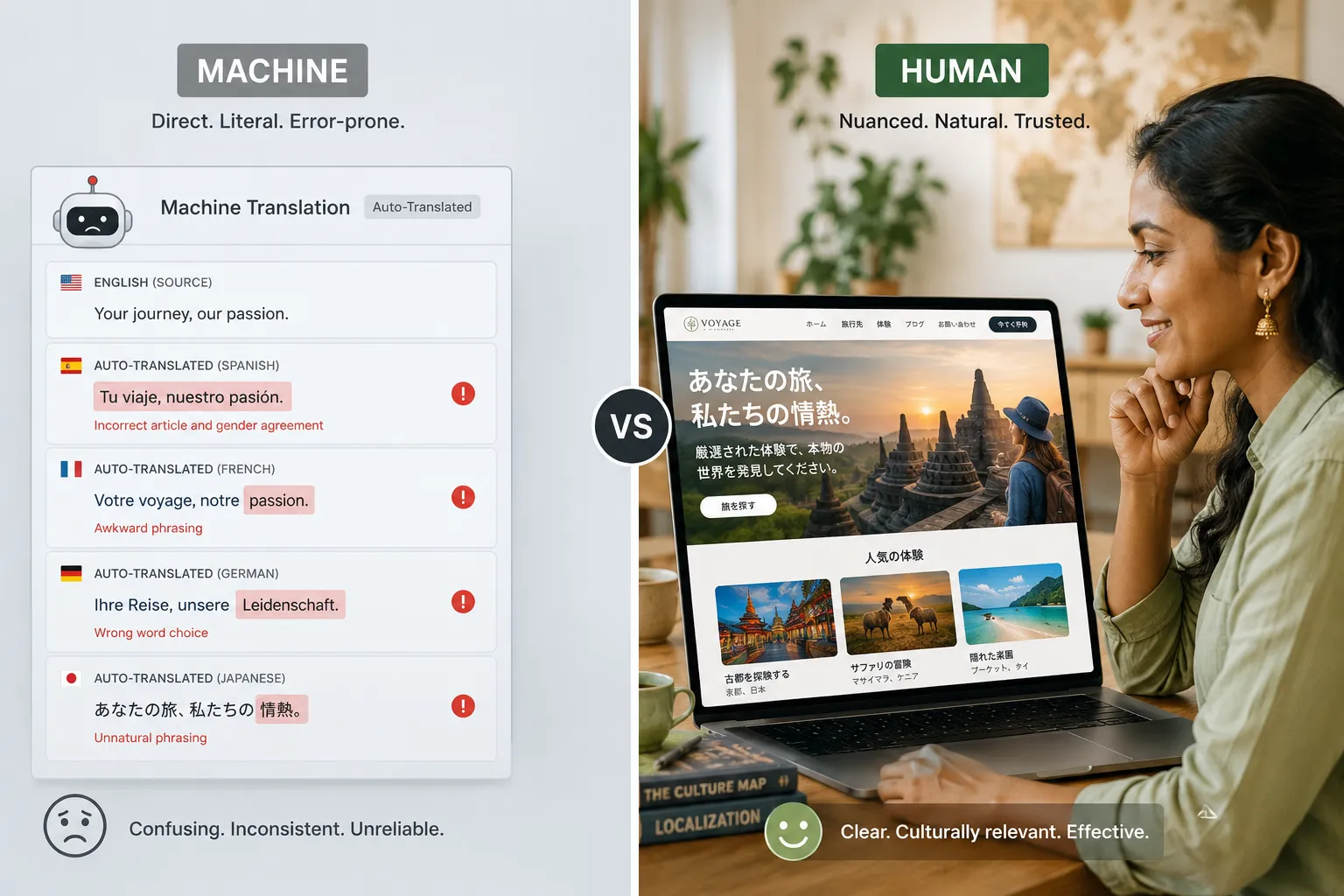
AI-powered translation has improved dramatically. Some analyses in 2026 cite accuracy rates of around 95% for many common language pairs [8]. That sounds reassuring, until you consider what the remaining 5% contains.
Machine translation fails most visibly in four areas:
- Idiomatic expressions, Phrases that make sense in English become nonsensical or offensive when translated literally
- Brand voice, Tone, humor, and personality are flattened by AI into neutral, generic text
- Cultural references, Examples, metaphors, and imagery that resonate with one audience can alienate another
- High-stakes pages, Legal terms, pricing language, and checkout copy require precision that machine output cannot guarantee without review
The industry has responded with AI-human hybrid workflows, which are now described as the dominant operational model for website localization in 2026 [2][9]. In this model, AI tools accelerate the initial translation pass, and human linguists, specialists in both the target language and the subject matter, review, correct, and adapt the output for tone, intent, cultural relevance, and brand consistency [2][6][11].
Machine translation is no longer experimental. It is embedded in professional workflows as a productivity tool, not a finished product [2][9]. The distinction matters for small business owners: using a free AI translation plugin and calling it done is not the same as using AI as part of a professionally managed localization process.
Where human review is non-negotiable:
- Homepage and brand messaging
- Product descriptions and feature pages
- Pricing pages and checkout flows
- Legal pages, privacy policies, and terms of service
- Any page that directly drives conversion
For lower-stakes content, archived blog posts, internal FAQs, lighter AI-assisted workflows may be acceptable. But for anything a customer reads before buying, human expertise is the quality gate.
The ROI Model: What Professional Website Translation for Business Actually Costs vs. Returns
The cost of professional website translation for business varies by language pair, page count, and content complexity. But the return side of the equation is measurable and documented.
Cost drivers to plan for:
- Number of source words (a typical small business website runs 5,000-15,000 words)
- Language pair complexity (European languages cost less than less-common pairs)
- Specialist knowledge required (legal, medical, or technical content commands higher rates)
- Ongoing updates, localization is not a one-time project [9][10]
Return drivers backed by data:
- 73% of companies report revenue growth after localizing content [1]
- Businesses now track revenue per language as a primary KPI, not just traffic [1][3]
- Conversion uplift and customer lifetime value in new markets are the key metrics [5]
The strategic recommendation from multiple 2026 analyses is to start with three to five priority languages based on existing traffic and revenue data, prove the model, then expand [1][5]. This approach keeps initial investment manageable while generating the data needed to justify further localization spend.
A practical way to frame the ROI: if your site currently converts 2% of visitors and you receive 1,000 monthly visitors from Germany who bounce because your site is English-only, even a conservative 1% conversion rate on a localized German site, at an average order value of $100, represents $1,000 in monthly revenue that currently does not exist. Professional translation of your core pages is a one-time cost that generates recurring returns.
Step-by-Step: How to Launch Your First Localized Website

Step 1: Identify Your Priority Markets
Pull your analytics. Where is your non-converting international traffic coming from? Which countries have the highest session counts but lowest conversion rates? Those are your first target markets. Prioritize three to five languages maximum for the first phase [1][5].
Step 2: Audit Your Priority Pages
Do not translate everything at once. Focus on pages that directly drive revenue [1]:
- Homepage
- Product or service pages
- Pricing page
- Checkout and cart
- Contact and support pages
Blog content and help articles can follow once the conversion funnel is localized.
Step 3: Brief Your Translator Properly
A vague brief produces generic output. A strong brief includes:
- Brand voice guide, formal or conversational? What words do you never use?
- Glossary of key terms, product names, features, taglines that must remain consistent
- Target audience profile, who is the reader in that market?
- Competitor context, what does the local competitive landscape look like?
- Legal requirements, what disclosures or consent language does that jurisdiction require? [4]
Step 4: Build for Multilingual SEO
Translation without SEO is a visibility failure. Work with your translator or a multilingual SEO specialist to:
- Research local-language keywords (not just translated English keywords)
- Implement hreflang tags correctly [4][6]
- Choose the right URL structure, subdirectory (/fr/), subdomain (fr.), or country-code domain (.fr)
- Optimize meta titles and descriptions in each language
Step 5: Set Up Continuous Localization
Every time you update your English site, new product, new pricing, new legal terms, every localized version must be updated in sync [9][10]. Treat localization as an ongoing operational process, not a one-time launch. Inconsistency across language versions is now treated as a failure by both users and search engines [10].
When to DIY vs. Hire a Professional Translator
DIY is acceptable for:
- Internal documents and non-public content
- Early-stage market testing (using AI drafts to gauge interest before committing)
- Simple, low-stakes informational content
Hire a vetted specialist for:
- Any customer-facing page
- Legal, compliance, or financial content
- Marketing copy and brand messaging
- Checkout and conversion flows
- Any content where an error could damage trust or create legal exposure
The most cost-effective and scalable path for a small business is to hire a curated, vetted freelance specialist, a professional translator with subject-matter expertise in your industry and native fluency in the target market. This approach gives you professional quality without the overhead of an in-house team or the unpredictability of unvetted generalist services.
When evaluating a translator, ask for:
- Native fluency in the target language (not just professional proficiency)
- Demonstrated experience in your industry vertical
- References or samples from comparable localization projects
- Familiarity with the target market’s legal and cultural context
Self-Audit Checklist: Is Your Site Ready to Go Global?
Before briefing a translator, confirm your site is structurally ready for localization. Work through this checklist:
Technical readiness:
- Your CMS supports multiple language versions (or has a localization plugin)
- URL structure is decided (subdirectory, subdomain, or ccTLD)
- Hreflang implementation is planned
- Site loads in under 3 seconds on mobile (critical for emerging markets) [4]
Content readiness:
- All source content is finalized, do not translate drafts
- Images do not contain embedded text that would need redesigning
- Date, currency, and measurement formats are parameterized, not hardcoded
- No culturally specific idioms or references that will not translate
Legal readiness:
- Privacy policy addresses the target jurisdiction’s data laws [4]
- Cookie consent flows meet local requirements (GDPR, LGPD, PIPL)
- Any regulated claims (health, financial, legal) are reviewed for local compliance
SEO readiness:
- Google Search Console is set up and verified
- Analytics can segment traffic and conversions by language/region
- Keyword research for target languages is planned
FAQ
How long does it take to localize a small business website?
For a focused scope, homepage, product pages, pricing, and checkout, a professional translator typically delivers a first draft within one to two weeks, depending on word count and language pair. Factor in an additional week for review, SEO implementation, and technical setup. Budget four to six weeks for a complete, polished launch.
Which languages should a small business prioritize first?
Start with languages that match your existing non-converting traffic. Common first choices for English-speaking businesses are Spanish (the largest non-English internet user base in the Americas), French, German, and Portuguese. Use your analytics data, not assumptions, to decide [1][5].
Is AI translation good enough for a business website?
AI translation has improved significantly and is now a standard part of professional workflows, but as a first-pass tool, not a finished product [2][9]. For customer-facing pages, AI output must be reviewed and adapted by a human linguist. Using AI alone on conversion-critical pages risks brand damage and lost sales.
What is the difference between a translator and a localizer?
A translator converts text between languages. A localizer adapts the full user experience, language, cultural references, legal requirements, UX, and SEO, for a specific market. For business websites, you need localization, not just translation [4][10].
How much does professional website localization cost?
Costs vary by language pair, word count, and content complexity. European language pairs (Spanish, French, German) are generally less expensive than less-common pairs. A professional translator typically charges per word or per project. Getting quotes from two or three vetted specialists for your specific scope will give you an accurate range without overpaying for generalist services.
How do I keep localized pages updated when my English site changes?
Build a continuous localization process: whenever you update the English source, flag those changes for translation immediately. Many businesses use a simple content changelog or a translation management system (TMS) to track what needs updating in each language [9][10]. Treat it like any other operational workflow, not an occasional project.
Conclusion
An English-only website in 2026 is not a neutral choice, it is an active decision to exclude the majority of the world’s online buyers. The data is clear: 40% of global shoppers will never purchase from a site in a foreign language [12], and 73% of businesses that localize their content see revenue growth as a result [1].
The path forward is not complicated, but it does require discipline:
- Identify your highest-potential non-English markets using your own analytics
- Localize your conversion funnel first, homepage, product pages, pricing, checkout
- Brief a vetted, specialist translator with a proper brand voice guide and glossary
- Build multilingual SEO into the process from day one, not as an afterthought
- Treat localization as a continuous operational process, not a one-time project
The businesses gaining ground in international markets right now are not the ones with the biggest budgets. They are the ones that made the decision to stop treating language as a barrier and start treating it as a growth lever. A curated, vetted freelance specialist gives a small business access to that same capability, without the cost of an in-house team.
The global customers are already searching. The only question is whether your site is ready to answer them in their language.
References
[1] Website Localization Trends 2026 What Smart Business Owners Are Doing Differently – https://www.linguise.com/blog/guide/website-localization-trends-2026-what-smart-business-owners-are-doing-differently/
[2] Website Localization In 2026 Which Trends Will Redefine Global Growth – https://www.somyatrans.com/website-localization-in-2026-which-trends-will-redefine-global-growth/
[3] 2026 Website Localization Trends – https://www.linguise.com/zh-cn/博客/指南/2026-年网站本地化趋势:精明的企业主正在采取哪些不同的做法/
[4] Website Localization The Complete Guide 2026 – https://linguidoor.com/website-localization-the-complete-guide-2026/
[5] The Top 10 Localization Trends To Watch In 2026 – https://www.getblend.com/blog/the-top-10-localization-trends-to-watch-in-2026/
[6] 5 Trends Should Change Your 2026 Localization Strategy – https://www.linkedin.com/pulse/5-trends-should-change-your-2026-localization-strategy-localizecorp-qk6vc
[7] AI Driven Localization Trends To Watch In 2026 – https://www.vistatec.com/ai-driven-localization-trends-to-watch-in-2026/
[8] Localization Trends Future Global Communication – https://taia.io/resources/blog/localization-trends-future-global-communication/
[9] Localization Trends 2026 How AI Is Rewriting Global Content Operations – https://lingohub.com/blog/localization-trends-2026-how-ai-is-rewriting-global-content-operations
[10] Website Localization Best Practices Guide – https://reverieinc.com/blog/website-localization-best-practices-guide/