
Last updated: August 10, 2026
Quick Answer: Inconsistent branding signals unreliability to potential customers before they ever read a word of your copy. For small businesses, a fragmented visual identity, mismatched logos, random fonts, conflicting color schemes across platforms, directly erodes buyer trust and perceived professionalism. The fix starts with a brand audit, a mood board, a clear design brief, and in most cases, working with a skilled freelance graphic designer to build a cohesive system that works across every touchpoint.
Key Takeaways
- Consistent branding is associated with revenue growth of 10-20%, according to research cited by brand consistency analysts [6]
- Consumers make trust judgments within seconds of seeing a brand’s visual presentation, inconsistency triggers doubt
- A brand identity for small business should include a logo system, defined color palette, typography rules, and templates for social, print, and presentations
- DIY templates can work early on, but they often create fragmentation that becomes expensive to fix later
- A mood board and design brief are the two most important documents to prepare before hiring a freelance graphic designer
- Brand guidelines and brand identity are related but different: identity is the visual system; guidelines are the rules for using it
- Small business owners can outsource graphic design affordably without sacrificing quality by working with vetted freelancers
- Fixing inconsistent branding across social media and a website can often be accomplished in 4-8 weeks with professional support
- Professional logo design is the single highest-leverage investment in a small business brand system
- Skipping brand identity work doesn’t save money, it costs sales, referrals, and perceived value
What Is Brand Identity and Why Does It Matter for Small Business
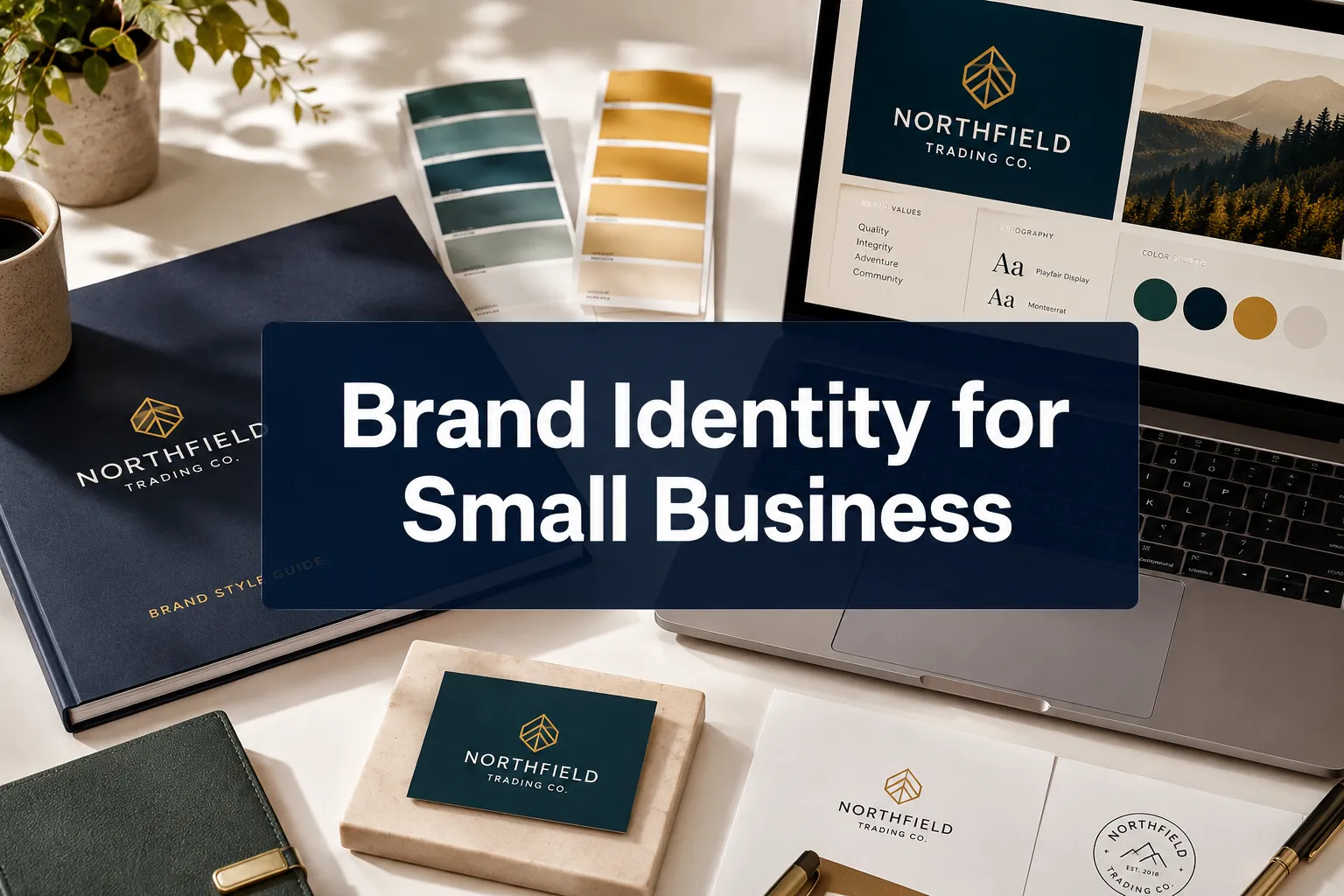
Brand identity is the complete visual and verbal system a business uses to present itself consistently, logo, colors, typography, imagery style, tone of voice, and how all of those elements appear together across every customer touchpoint. For small businesses, a strong brand identity for small business is not a luxury reserved for companies with large marketing budgets. It is the foundation that determines whether a potential customer decides to trust you or click away.
Trust is now the primary gatekeeper for purchase decisions [1]. When a buyer encounters a business for the first time, whether on Instagram, a Google search result, a business card, or a pitch deck, their brain is running a rapid credibility assessment. Visual consistency is one of the fastest signals it uses. A polished, coherent brand says: “This business is organized, reliable, and worth my money.” A scattered one says the opposite, even if the product or service is excellent.
Why this hits small businesses hardest: Large companies have brand teams enforcing consistency. Small business owners are juggling operations, sales, and marketing simultaneously, which means branding decisions get made reactively, a new social graphic here, a different font on a flyer there, and the inconsistency compounds over time.
How Does Inconsistent Branding Affect Customer Trust
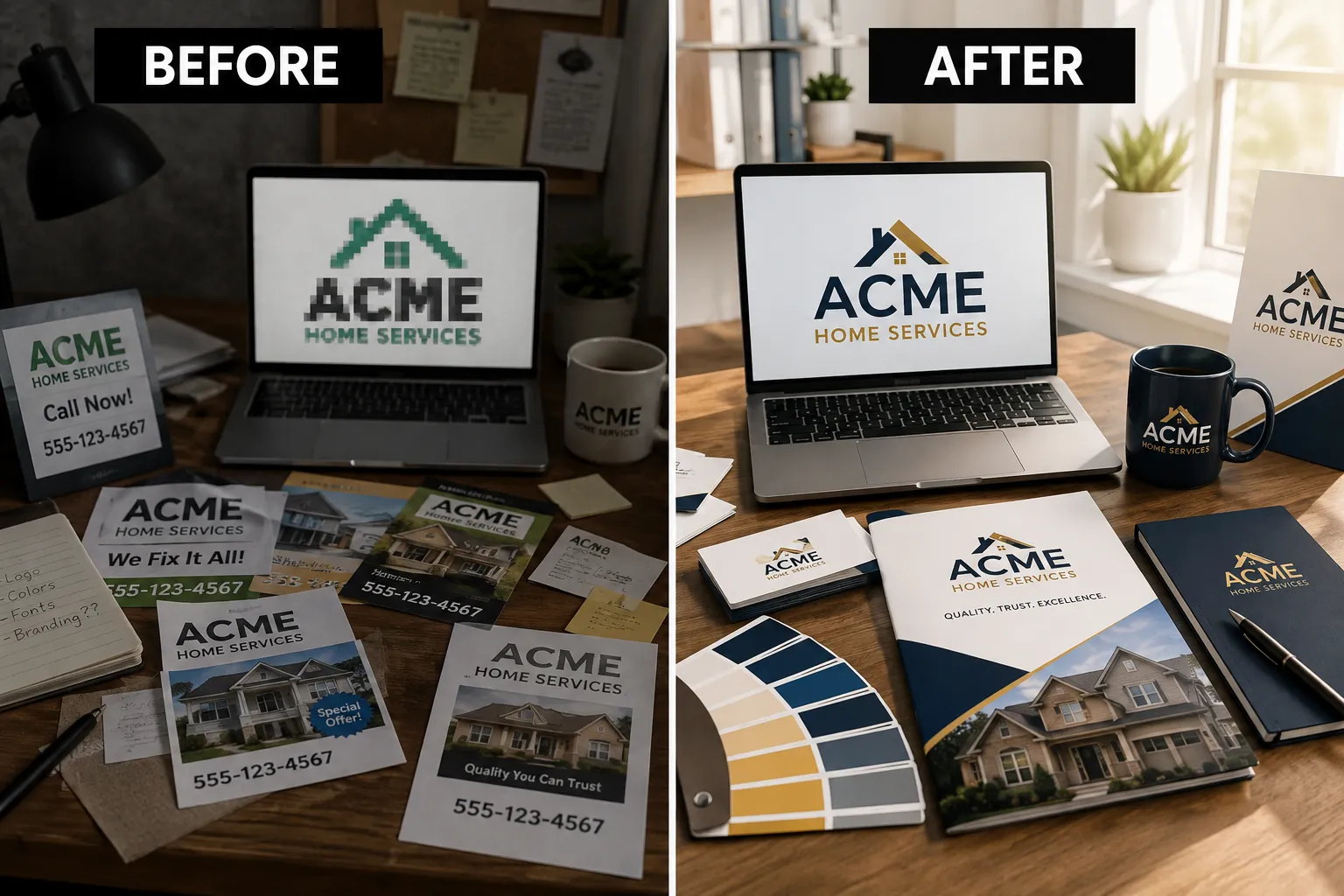
Inconsistent branding directly undermines customer trust by creating cognitive dissonance, the uncomfortable feeling that something doesn’t quite add up. When a buyer sees three different logo versions across your website, Instagram, and invoice, they register the mismatch even if they can’t articulate why.
Research consistently shows that brand consistency is linked to meaningful revenue gains. Studies cited by brand consistency analysts suggest consistent brand presentation can contribute to revenue growth in the range of 10-20% [6]. The inverse is also true: inconsistent presentation leaves that growth unrealized because buyers hesitate, doubt, or simply move on to a competitor who looks more established.
The psychological mechanism works like this:
- The brain uses visual consistency as a proxy for operational consistency
- A mismatched brand implies disorganization, which implies risk
- Risk aversion is a powerful purchase blocker, especially for first-time buyers
- Trust, once lost at the visual level, is hard to recover through copy or testimonials alone
According to the Edelman Trust Barometer Special Report on Brands, trust is now a leading driver of purchase decisions, with consumers actively choosing brands they perceive as credible and reliable [1]. For small businesses competing against more established players, visual credibility is one of the few levers that can level the playing field quickly.
What Are the Signs My Small Business Branding Is Hurting My Credibility
Several specific warning signs indicate that a small business’s branding is actively working against it. If any of the following are true, the brand identity for small business needs attention.
Check for these red flags:
- Your logo looks different on your website, business cards, and social profiles
- You use more than two or three fonts across your marketing materials
- Your color palette varies from platform to platform (different shades of “your blue” everywhere)
- Your Instagram feed looks nothing like your website
- Your email signature, invoices, and proposals use different visual styles
- You’ve never written down your brand colors as hex codes or Pantone values
- New marketing materials are created by whoever has time, with no visual reference point
- Customers or prospects have ever asked “wait, is this the same company?”
Any one of these is a signal. Multiple together mean the brand is actively costing credibility. Research on omnichannel brand consistency confirms that buyers expect a unified experience across every channel they encounter a brand on, and when that experience breaks down, engagement and conversion rates suffer [2].
What Happens If You Don’t Have Consistent Branding
Without consistent branding, small businesses pay a compounding price across sales, marketing efficiency, and perceived value. The short-term cost is missed conversions. The long-term cost is a ceiling on how premium the business can position itself.
Specifically, inconsistent branding tends to produce these outcomes:
- Lower perceived value: Buyers anchor price expectations to visual signals. A polished brand commands higher prices; a scattered one invites price negotiation
- Weaker word-of-mouth: People recommend businesses they feel confident referring, visual inconsistency creates hesitation
- Higher marketing costs: Every new campaign has to rebuild trust from scratch rather than building on an established visual reputation
- Difficulty scaling: As the business grows and more people create content or materials, the inconsistency multiplies without a brand system to anchor it
Branding statistics show that a significant majority of consumers need to encounter a brand multiple times before making a purchase decision [5]. Inconsistency across those encounters resets the trust clock rather than building it.
Brand Identity vs. Brand Guidelines: What’s the Difference
Brand identity is the actual visual system, the logo, color palette, typography, icon set, and imagery style. Brand guidelines (also called a brand style guide) are the documented rules that explain how to use that identity correctly and consistently.
Think of it this way: the brand identity is the toolkit, and the brand guidelines are the instruction manual. Small businesses often invest in creating a logo (the most visible piece of the identity) but skip writing the guidelines. That’s where inconsistency creeps in, because without documented rules, every new piece of content becomes a guessing game.
A complete brand identity for small business typically includes:
- Primary and secondary logo versions (horizontal, stacked, icon-only)
- Defined color palette with exact hex, RGB, and CMYK values
- Typography system (heading font, body font, and usage rules)
- Imagery and photography style guidelines
- Tone of voice and messaging principles
- Usage rules: what not to do with the logo, minimum sizes, clear space requirements
Brand guidelines then specify:
- How the logo appears on light vs. dark backgrounds
- Which colors are used for which purposes
- How templates for social media, presentations, and print should be structured
Without both pieces, even a well-designed identity falls apart in execution.
Common Branding Mistakes Small Businesses Make
The most common branding mistakes among small businesses are not about bad taste, they’re about process gaps. Most founders simply haven’t been taught what a brand system requires.
The most frequent mistakes:
- Treating the logo as the entire brand. A logo is one element. Without a supporting color system, typography, and templates, it can’t carry the whole identity.
- Using too many fonts. Free design tools offer hundreds of font options, and the temptation to use them is real. Two fonts, one for headings, one for body, is almost always enough.
- Inconsistent color usage. Eyeballing “close enough” shades across different platforms creates visual noise that erodes brand recognition over time.
- No templates for recurring content. Without social media templates, every post becomes a new design decision, and the results look it.
- Skipping the design brief. Jumping straight into design without a written brief leads to revisions, miscommunication, and a final product that doesn’t align with the business’s actual positioning.
- Choosing a designer based on price alone. The cheapest option often produces a logo that looks like thousands of others, because it was generated from a stock template with minimal customization.
- Never documenting brand decisions. When the person who “knows the brand” leaves or the business grows, undocumented decisions disappear with them.
Do I Need a Graphic Designer, or Can I Do Branding Myself
For very early-stage businesses testing a concept, DIY tools like DIY design tools can produce functional materials. But there is a meaningful difference between functional and credible, and that gap widens as the business matures.
The honest answer: DIY templates tend to look like DIY templates. They share visual DNA with thousands of other businesses using the same platform, which makes differentiation nearly impossible. More importantly, they rarely produce the brand system a growing business needs, they produce individual assets with no connective logic.
When to hire a freelance graphic designer:
- You’re moving from side project to serious business
- You’re preparing for a sales push, investor pitch, or partnership conversation
- Your current materials don’t reflect the quality of what you actually deliver
- You’re losing deals to competitors who look more established
- You need a full system, not just a logo
What a skilled freelance graphic designer can help with:
- Professional logo design with multiple use-case versions
- A defined color palette and typography system
- Social media templates that maintain brand consistency without requiring design skills to use
- Presentation and pitch deck templates
- Affordable marketing materials: brochures, flyers, email headers, and print collateral
- A brand style guide that documents everything for future use
When you outsource graphic design to a qualified professional, you’re not just buying a file, you’re buying a system that makes every future piece of content faster and more consistent to produce.
How Much Does Professional Brand Identity Design Cost for Small Business
Professional brand identity design for small businesses varies widely based on scope, designer experience, and deliverables. There is no single correct number, but understanding the ranges helps set realistic expectations.
General cost ranges (estimates based on typical market rates in 2026):
- Logo only (freelance): $300 to $1,500 for a professional custom design
- Logo plus basic brand guidelines: $800 to $3,000
- Full brand identity system (logo, colors, typography, templates, style guide): $2,000 to $8,000+
- Agency-level branding: $10,000 and up
For small businesses on tighter budgets, working with a vetted mid-level freelance graphic designer often delivers the best value, more customization than a template service, at a fraction of agency pricing. The key is coming prepared with a strong design brief and mood board, which reduces revision cycles and keeps costs predictable.
Cost-saving strategies that don’t sacrifice quality:
- Prepare thorough reference materials before the project starts
- Define the scope clearly (logo only vs. full system) so there are no scope creep surprises
- Start with a logo and core guidelines, then expand the system over time
- Use the delivered templates to produce your own content going forward
How to Create a Brand Identity on a Tight Budget
A tight budget does not mean a weak brand identity for small business, it means prioritizing the highest-leverage elements first and building the system incrementally.
A practical sequence for budget-conscious founders:
- Start with a brand audit (free): Document every place your brand currently appears and identify the inconsistencies
- Build a mood board (free to low-cost): Collect visual references that represent the feeling and positioning you want, colors, typography styles, imagery, competitor brands you admire
- Write a design brief (free): Define your target audience, brand personality, key differentiators, and what you want the brand to communicate
- Invest in professional logo design first: This is the highest-leverage single asset, get it right before anything else
- Define your color palette and fonts: Even if you do this yourself based on the logo, document the exact values
- Create templates for your most-used formats: Social posts, email headers, and one presentation template cover 80% of ongoing needs
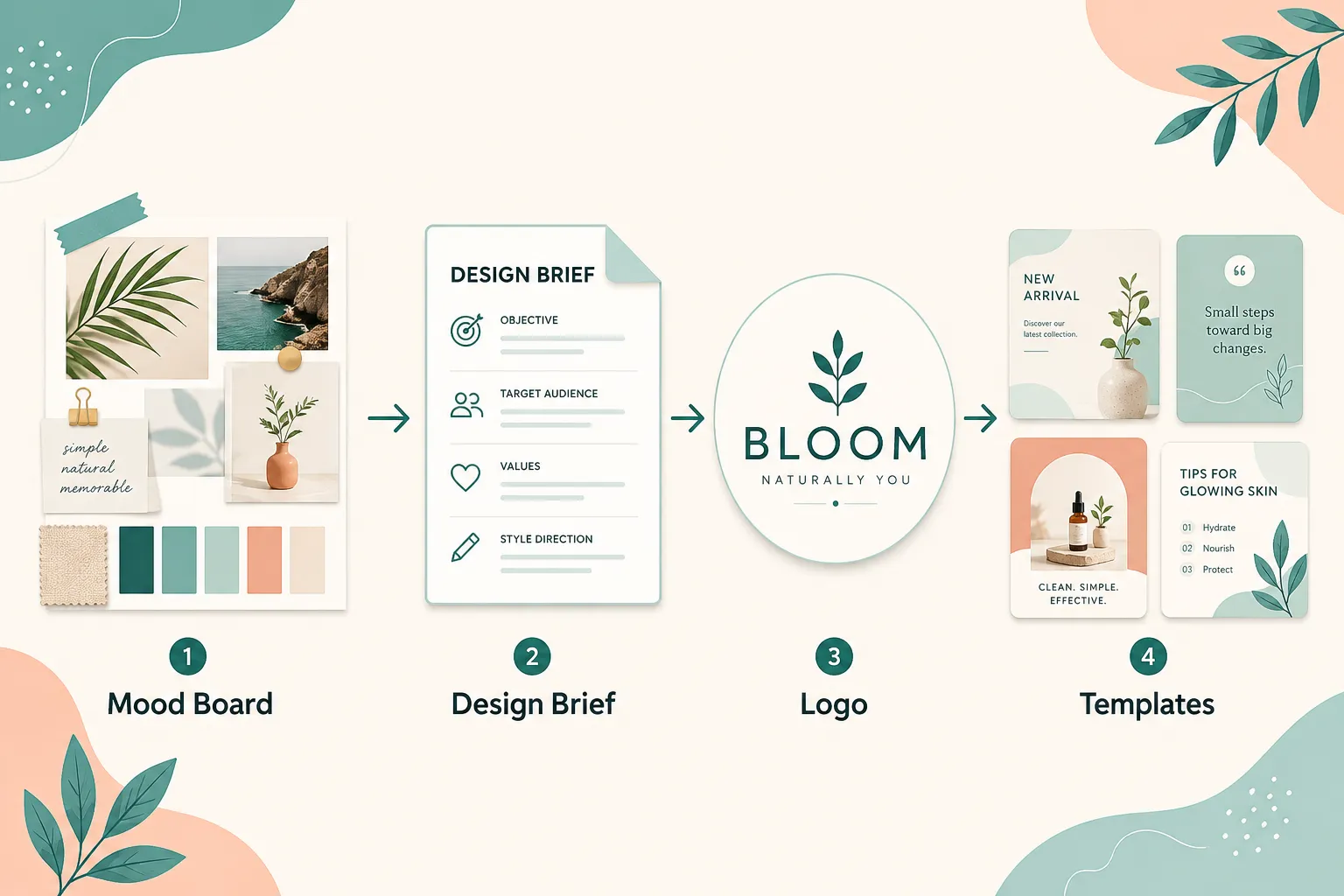
The mood board and design brief are especially important when working with a freelance designer on a budget, because they dramatically reduce back-and-forth and keep the project on track.
What Should Be Included in a Design Brief for Branding
A design brief is a written document that gives a graphic designer the context they need to produce work that actually fits the business. A strong brief is the single most effective way to reduce revisions and get a result that aligns with the brand’s goals.
A complete branding design brief should cover:
- Business overview: What the business does, who it serves, and what makes it different
- Target audience: Demographics, psychographics, and what matters to them when choosing a provider
- Brand personality: Three to five adjectives that describe how the brand should feel (e.g., “trustworthy, modern, approachable”)
- Competitive landscape: Who the main competitors are and how the brand should be positioned relative to them
- Visual preferences: Colors, styles, and references the client likes, and equally important, what they don’t like
- Deliverables: Exactly what files and formats are needed (logo files, social templates, pitch deck template, etc.)
- Usage contexts: Where the brand will appear, print, digital, merchandise, signage, presentations
- Timeline and budget: Clear parameters so the designer can scope the work accurately
A mood board attached to the brief is worth more than a paragraph of description. Visual references communicate nuance that words often miss.
How to Use a Mood Board to Develop Brand Identity
A mood board is a curated collection of visual references, images, color swatches, typography samples, textures, and examples from other brands, that communicates the intended look and feel of a brand before any design work begins.
For small business owners who aren’t designers, the mood board is the most accessible and effective tool for communicating visual direction. It replaces vague language (“I want it to look professional but friendly”) with concrete visual evidence.
How to build an effective mood board:
- Gather references broadly first: Pull images from Pinterest, design inspiration sites, competitor websites, packaging you admire, and magazine layouts that feel right
- Look for patterns: After collecting 20-30 references, notice which colors, textures, and styles appear repeatedly, those patterns reveal the brand’s visual instincts
- Narrow to 10-15 strong references: Curate ruthlessly. Every image on the final board should feel intentional
- Include non-brand references: Nature photography, interior design, fashion, and product photography can all communicate brand feeling effectively
- Add color swatches: Pull the dominant colors from your favorite references and group them, this often becomes the seed of the color palette
- Share it with your designer before the brief conversation: A mood board makes that first conversation dramatically more productive
Tools like visual research boards and simple mood-board documents all work well for this purpose.
How to Fix Inconsistent Branding Across Social Media and Website
Fixing inconsistent branding is a systematic process, not a single design decision. It starts with a full audit and ends with documented standards and templates that prevent future drift.
Step-by-step brand consistency fix:
- Conduct a brand touchpoint audit: List every place the brand appears, website, social profiles (each platform separately), email signature, invoices, proposals, business cards, printed materials, presentations, packaging
- Screenshot everything: Visual documentation makes inconsistencies obvious in a way that memory does not
- Identify the core problems: Are the logo versions different? Are the colors inconsistent? Are there too many fonts? Prioritize the most visible issues
- Establish the canonical versions: Decide on the definitive logo, exact color codes, and typography, this becomes the reference point for everything else
- Update high-visibility touchpoints first: Website header, social profile images, and email signature are seen most often, fix these first
- Create templates for recurring content: Social post templates, email header templates, and a presentation deck template prevent future inconsistency
- Document the standards: Even a one-page brand reference sheet with the logo, hex codes, and font names is enough to keep a small team aligned
- Schedule a quarterly review: Brand drift happens gradually, a regular check catches it before it compounds
Working with a freelance graphic designer to execute steps 4-7 is often the fastest path, particularly if the existing brand assets need to be rebuilt from scratch.
How Long Does It Take to Develop a Consistent Brand Identity
For most small businesses, developing a complete brand identity takes four to eight weeks when working with a professional designer and starting with a clear brief. The timeline varies based on scope, how quickly the client provides feedback, and how many revision rounds are needed.
Typical project phases and timeframes:
- Discovery and brief: 3-5 days (client-driven)
- Mood board review: 2-3 days
- Initial logo concepts: 5-7 business days
- Logo refinement and selection: 3-5 days
- Color, typography, and system development: 5-7 days
- Template creation (social, presentation, print): 5-10 days
- Brand guidelines document: 3-5 days
The biggest variable is client response time. Projects where feedback comes back within 24-48 hours consistently finish faster and with fewer revisions than those where communication is intermittent.
For businesses that need to move faster, ahead of a launch, investor meeting, or trade show, a focused scope (logo plus core guidelines) can often be completed in two to three weeks.
Brand Identity Examples for Small Business: What Good Looks Like
Strong brand identity for small business doesn’t require a massive budget, it requires consistency, intentionality, and a clear point of view. The best small business brands share a few observable characteristics.
What well-executed small business branding looks like in practice:
- A logo that works at every size, from a favicon to a banner, without losing clarity
- A color palette of two to four colors that appears consistently across every platform
- Typography that is readable, distinctive, and used consistently (same fonts, same hierarchy rules, every time)
- Social media content that looks like it belongs to the same family, even across different post types
- Marketing materials, business cards, brochures, pitch decks, that feel like they came from the same source
- A website that matches the social presence, which matches the printed materials
The contrast with inconsistent branding is immediate. When a business’s Instagram looks like a different company than its website, or its pitch deck uses clip art while its business card looks polished, the mismatch registers as a credibility gap. Affordable marketing materials that are consistently designed outperform expensive one-off pieces that don’t fit the broader visual system.
Brand Identity Checklist for Small Business Owners
Use this checklist to assess where the brand currently stands and what needs to be built or fixed.
Foundation
- Logo exists in multiple formats (SVG, PNG transparent, white version, dark version)
- Exact color codes are documented (hex for digital, CMYK for print)
- Two to three fonts are defined and documented
- Brand personality adjectives are written down
Digital Touchpoints
- Website uses the correct logo, colors, and fonts consistently
- All social media profile images use the same logo version
- Social media cover images are consistent across platforms
- Email signature matches the brand
Templates
- Social media post templates exist for at least two formats
- Presentation or pitch deck template is built and in use
- Email newsletter template matches the brand
- Invoice and proposal templates match the brand
Print and Marketing Materials
- Business cards are current and consistent
- Any printed brochures or flyers match the digital brand
- Signage (if applicable) uses correct logo and colors
Documentation
- A brand style guide or reference sheet exists
- The guide is accessible to anyone who creates content for the business
- Brand assets are stored in a shared, organized location
Frequently Asked Questions
What is the most important element of brand identity for a small business?
The logo is the most visible single element, but the color palette is arguably the most important for consistency. Colors are processed faster than shapes, and consistent color use across platforms builds recognition more quickly than any other visual element.
Can I use DIY design tools to build a professional brand identity?
DIY design tools can produce functional materials, but it has limitations for building a true brand system. The risk is that your brand ends up looking similar to thousands of other businesses using the same templates. For early-stage testing, it works. For a business ready to compete seriously, professional logo design and a custom system are worth the investment.
What should I look for when I hire a freelance graphic designer for branding?
Look for a portfolio that shows brand identity work specifically, not just illustration or web design. Check that their past work shows consistency across multiple touchpoints (logo, social, print). Ask whether they deliver brand guidelines alongside the logo files, and confirm they provide vector source files (AI or EPS) that you own outright.
How do I know if my current branding is hurting my business?
The clearest signal is a gap between the quality of what you deliver and how your brand looks. If you’re losing deals to competitors whose work isn’t better but whose brand looks more established, visual credibility is likely a factor. A quick audit, screenshotting every customer-facing touchpoint and laying them side by side, usually makes the problem obvious.
Is it worth outsourcing graphic design if I’m a very small business?
Yes, particularly for the foundational elements. A one-time investment in professional logo design and a basic brand system pays dividends across every piece of marketing content the business ever produces. The cost of inconsistency, in lost sales, lower perceived value, and the time spent making ad hoc design decisions, typically exceeds the cost of getting it right once.
What is a design brief and do I really need one?
A design brief is a written document that defines the project scope, audience, brand personality, visual preferences, and deliverables before design work begins. It is not optional if you want predictable results. Without a brief, designers guess at what you want, revisions multiply, and the final product often misses the mark. A one-to-two page brief is enough to dramatically improve outcomes.
Conclusion
Inconsistent branding is one of the most common and most fixable credibility problems small businesses face. The cost is real, in buyer hesitation, lower perceived value, and missed revenue, but so is the solution. A clear brand identity for small business doesn’t require an agency budget or a design background. It requires a systematic approach: audit what exists, define what the brand should communicate, build the visual system with the right support, and document it so it stays consistent as the business grows.
The practical path forward is straightforward. Start with a brand touchpoint audit this week. Build a mood board using free tools. Write a one-page design brief. Then, when the foundation is clear, work with a skilled freelance graphic designer to build the logo system, color palette, typography rules, and templates that will carry the brand forward consistently.
Consistency is not about perfection, it’s about showing up the same way, every time, across every channel. That reliability is what builds the trust that converts browsers into buyers and buyers into advocates. The businesses that invest in that foundation early are the ones that look established when they’re still small, and scale without the expensive rebrand that inconsistency eventually demands.
References
[1] Special Report Brands – https://www.edelman.com/trust/2025/trust-barometer/special-report-brands
[2] Maintain Omnichannel Brand Consistency – https://www.flipflow.io/en/blog-en/maintain-omnichannel-brand-consistency/
[5] Branding Statistics – https://shapo.io/blog/branding-statistics/
[6] Brand Consistency Statistics – https://www.omnibound.ai/blog/brand-consistency-statistics