

Wor
Want the complete map? This guide is part of our Small Business AI Automation master guide, which walks you end to end from baseline to finished automation.
kers spend an average of 40% of their time on tasks that could be automated, yet most organizations have only scratched the surface of what modern tools can do. [5] The opportunity to automate repetitive tasks is no longer limited to large enterprises with dedicated IT teams. In 2026, accessible platforms, AI-powered bots, and agentic workflows have made task automation a practical strategy for businesses of every size. This guide breaks down the most effective methods, tools, and frameworks to eliminate manual busywork and redirect human effort toward work that actually matters.
Key Takeaways
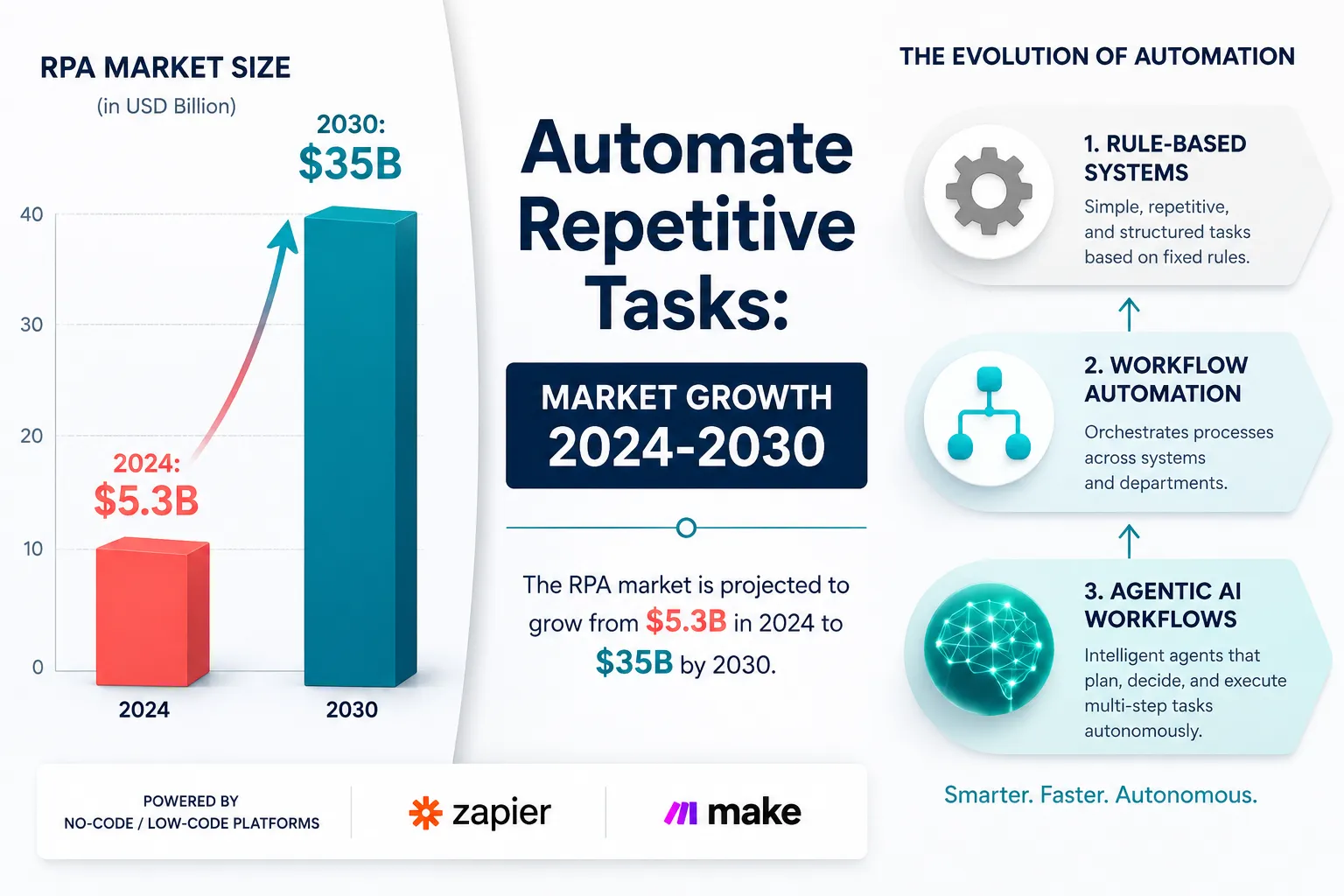
- The robotic process automation (RPA) market is on track to reach $35 billion by 2030, up from $5.3 billion in 2024, signaling massive mainstream adoption [9]
- Agentic AI workflows now allow software to plan, decide, and execute multi-step tasks with minimal human input [1]
- No-code and low-code platforms have made it possible for non-technical teams to automate repetitive tasks without developer support
- Automation tools span every business function, from HR and finance to IT and marketing
- A phased implementation approach reduces risk and accelerates return on investment
Why the Pressure to Automate Repetitive Tasks Has Never Been Greater
The business case for automation is straightforward: repetitive tasks drain time, introduce human error, and demoralize skilled employees. But the urgency has intensified in 2026 for several reasons.
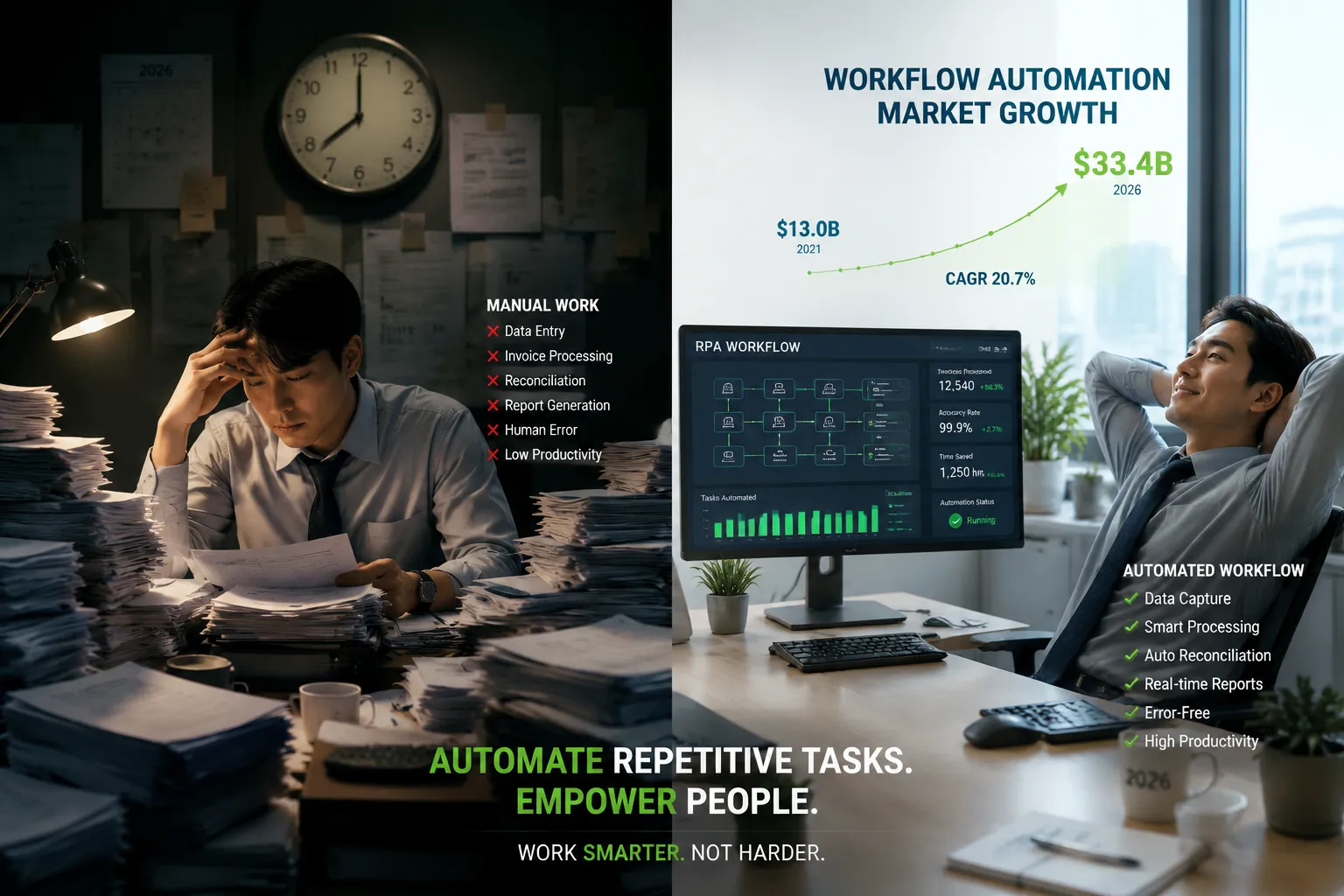
Market growth tells the story. The global workflow automation market is expanding rapidly, driven by AI integration, cloud adoption, and the demand for operational efficiency. [8] The RPA sector alone is projected to grow from $5.3 billion in 2024 to $35 billion by 2030, a compound annual growth rate that reflects how seriously organizations are investing in this space. [9]
Labor costs are rising. As wages increase across sectors, the financial argument for automating routine work becomes even more compelling. Every hour a knowledge worker spends on data entry, report formatting, or manual approvals is an hour not spent on strategy, client relationships, or innovation.
AI has changed the ceiling. Early automation tools could only handle simple, rule-based tasks. Today’s cognitive RPA and agentic AI systems can interpret unstructured data, make contextual decisions, and adapt to changing conditions, capabilities that were not commercially viable just three years ago. [9]
“Automation is no longer a competitive advantage, it is quickly becoming a baseline expectation for operational competence.”
Understanding the Landscape: Types of Automation Available Today
Before choosing tools, it helps to understand the categories of automation on the market.
Rule-Based Automation
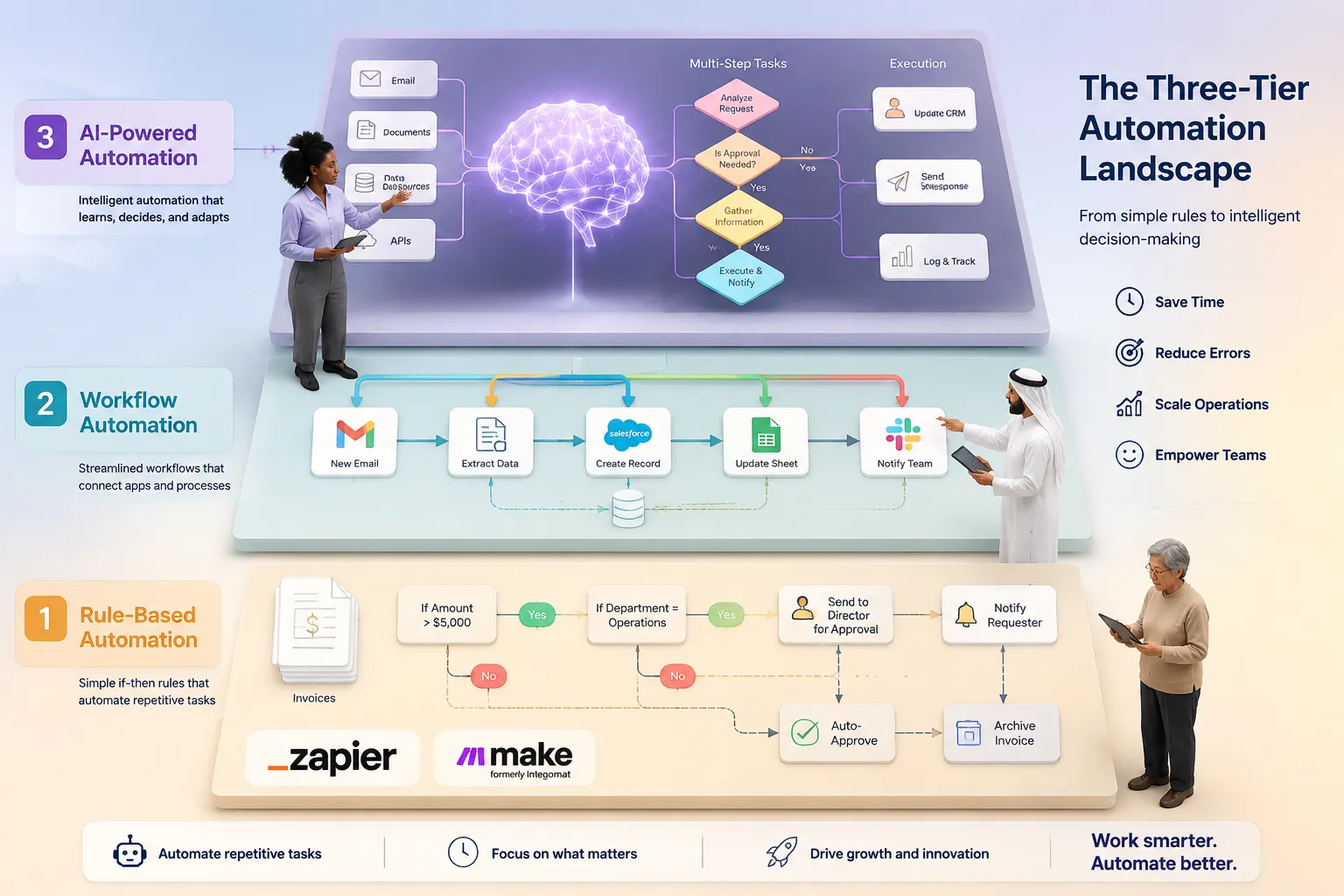
This is the foundation of most automation programs. Rule-based systems follow explicit if-then logic: if an invoice arrives, extract the data and route it for approval. Tools like Zapier, Make (formerly Integromat), and Microsoft Power Automate excel here.
Robotic Process Automation (RPA)
RPA uses software bots to mimic human actions on a computer, clicking, typing, copying, and pasting across applications. It is especially useful when systems lack APIs. Major RPA vendors include UiPath, Automation Anywhere, and Blue Prism.
AI-Powered and Cognitive Automation
Cognitive automation adds machine learning and natural language processing to the mix. These systems can read emails, classify documents, and handle exceptions that would stump a rule-based bot. [9]
Agentic Workflow Automation
The newest category involves AI agents that can plan sequences of actions, use tools autonomously, and loop back to correct mistakes. Platforms like those highlighted in recent agentic workflow research can handle complex, multi-step processes with minimal human oversight. [1] [10]
- Level 1, Task Automation: Single-step, rule-based triggers (e.g., auto-reply emails)
- Level 2, Process Automation: Multi-step workflows across tools (e.g., lead capture to CRM to Slack alert)
- Level 3, Intelligent Automation: AI-assisted decisions within workflows (e.g., sentiment-based ticket routing)
- Level 4, Agentic Automation: Autonomous AI agents that plan and execute entire job functions
15 Ways to Automate Repetitive Tasks Across Your Organization
1. Automate Email Triage and Responses
Email is one of the biggest time sinks in any organization. Tools like Gmail filters, Outlook rules, and AI-powered email assistants can sort, label, prioritize, and even draft replies automatically. Connecting email to a CRM via Zapier or Make means every new inquiry is logged without manual entry.
2. Streamline Data Entry with RPA Bots
Data entry errors cost businesses billions annually. RPA bots can extract data from invoices, forms, and spreadsheets and push it directly into ERP or CRM systems, faster and more accurately than any human. [6]
3. Automate Report Generation
Scheduled reports that pull from live dashboards, built in tools like Power BI, Looker, or Google Data Studio, eliminate the need for weekly manual exports. Set the schedule once; the report arrives in inboxes automatically.
4. Use No-Code Platforms for Cross-App Workflows
Platforms such as Zapier, Make, and n8n let non-technical users connect hundreds of apps without writing a single line of code. A typical workflow might capture a form submission, create a task in a project management tool, and send a Slack notification, all in seconds.
5. Automate HR Onboarding Processes
New-hire onboarding involves dozens of repetitive steps: account creation, document collection, training assignments, and equipment requests. Platforms like JumpCloud now offer workflow automation specifically designed to handle IT provisioning and access management at scale, reducing manual IT tasks dramatically. [3]
6. Schedule Social Media Posts
Social media management tools like Buffer, Hootsuite, and Sprout Social allow teams to batch-create content and schedule posts weeks in advance. Some platforms now use AI to optimize posting times based on audience engagement data.
7. Automate Invoice Processing and Accounts Payable
Optical character recognition (OCR) combined with RPA can extract data from incoming invoices, match them against purchase orders, flag discrepancies, and route approved invoices for payment, all without human intervention.
8. Set Up Automated Customer Support Workflows
AI chatbots handle tier-1 support queries around the clock. When a query exceeds the bot’s capability, the conversation is escalated to a human agent with full context already captured. This hybrid model reduces average handle time significantly.
9. Automate Repetitive Tasks in Project Management
Platforms like Jira now integrate AI agents directly into project workflows. Atlassian’s recent update fuses an AI agent work surface, workflow engine, and control plane into Jira, allowing teams to automate task assignment, status updates, and sprint planning triggers. [4]
10. Use AI Agents for Research and Summarization
Agentic AI tools can browse the web, pull relevant data, and produce structured summaries on demand. This is particularly valuable for competitive intelligence, market research, and content briefing, tasks that previously required hours of manual effort. [1]
11. Automate IT Provisioning and Access Management
IT teams spend enormous time creating accounts, assigning permissions, and deprovisioning departed employees. Automated identity management workflows triggered by HR system events can handle this end-to-end. [3]
12. Trigger Automated Follow-Up Sequences in Sales
CRM platforms like HubSpot and Salesforce include sequence automation that sends personalized follow-up emails based on prospect behavior, opens, clicks, page visits, without requiring a sales rep to manually monitor each lead.
13. Automate Compliance and Audit Logging
Regulatory compliance requires consistent documentation. Automated logging tools capture every action in a system, timestamp it, and store it in a searchable audit trail, removing the need for manual compliance reporting.
14. Use Workflow Automation for Content Publishing
Content management systems connected to automation platforms can trigger publishing workflows: a draft approved in one tool automatically publishes to a website, notifies the social media scheduler, and updates a content calendar, all without manual coordination. [10]
15. Deploy Agentic Workflows for Complex, Multi-Step Processes
The most advanced organizations are deploying AI agents that can handle entire job functions autonomously. Agentic workflow automation platforms allow these agents to use tools, call APIs, interpret results, and loop back to correct errors, representing a fundamental shift in how knowledge work gets done. [1] [2]
How to Build an Automation Strategy That Actually Works
Knowing which tasks to automate is only half the battle. A structured approach prevents wasted effort and failed implementations.
Step 1: Audit Your Repetitive Tasks
List every task your team performs more than twice a week. Note the time spent, error rate, and level of rule-based predictability. High-volume, high-frequency, low-judgment tasks are the best automation candidates.
Step 2: Prioritize by ROI
Not all automation projects deliver equal returns. Use a simple scoring matrix:
| Factor | Weight |
|---|---|
| Time saved per week | High |
| Error reduction potential | High |
| Implementation complexity | Medium |
| Cost of current manual process | High |
Focus first on tasks that score high on time saved and error reduction with low implementation complexity.
Step 3: Choose the Right Tools
Match the tool to the task type. Rule-based, single-app tasks suit native automation features. Cross-app workflows benefit from no-code platforms. High-volume, structured data tasks are ideal for RPA. Complex, judgment-heavy processes may warrant agentic AI. [5]
Step 4: Pilot Before Scaling
Run a controlled pilot on one team or process before rolling out organization-wide. Measure baseline metrics, run the automation for four to six weeks, and compare results. This approach surfaces edge cases before they become expensive problems.
Step 5: Monitor, Maintain, and Improve
Automated workflows are not set-and-forget systems. Processes change, APIs update, and business rules evolve. Assign ownership for each automation and schedule quarterly reviews to ensure continued accuracy and relevance.
Common Mistakes When Trying to Automate Repetitive Tasks
Even well-intentioned automation projects fail. These are the most frequent pitfalls:
- Automating a broken process. Automation amplifies whatever it touches, including inefficiency. Fix the process first, then automate it.
- Underestimating exception handling. Real-world data is messy. Build exception paths into every workflow from the start.
- Ignoring change management. Employees who feel threatened by automation disengage. Frame automation as a tool that removes drudgery, not a replacement for people.
- Choosing tools before defining needs. Vendor demos are compelling. Define requirements independently before evaluating platforms.
- Skipping documentation. Undocumented automations become black boxes that no one can maintain when the original builder leaves.
FAQ: Automating Repetitive Tasks
What types of tasks are best suited for automation?
Tasks that are high-volume, rule-based, time-consuming, and prone to human error are the strongest candidates. Examples include data entry, report generation, email routing, invoice processing, and IT provisioning.
Do you need coding skills to automate repetitive tasks?
Not necessarily. No-code platforms like Zapier, Make, and Microsoft Power Automate allow non-technical users to build sophisticated workflows using drag-and-drop interfaces. More complex or custom automations may require developer involvement.
How long does it take to see ROI from task automation?
Simple automations can deliver measurable time savings within days of deployment. More complex RPA or agentic AI implementations typically show clear ROI within three to six months, depending on process complexity and adoption rate.
What is the difference between RPA and agentic AI automation?
RPA mimics human actions on a computer using predefined rules and scripts. Agentic AI goes further, it can plan sequences of actions, interpret unstructured data, use external tools, and adapt to changing conditions with minimal human oversight. [1] [9]
Is automation safe for sensitive business processes?
Yes, when implemented correctly. Enterprise automation platforms include role-based access controls, audit logging, and encryption. Compliance-sensitive workflows should be reviewed by legal and IT security teams before deployment.
What is the biggest risk of automating repetitive tasks?
The most common risk is automating a flawed process, which scales the problem rather than solving it. A close second is poor exception handling, when an automated workflow encounters an unexpected input and fails silently, errors can compound before anyone notices.
Conclusion
The ability to automate repetitive tasks has moved from a technical luxury to a strategic necessity. With the RPA market approaching $35 billion by 2030 [9] and agentic AI platforms reshaping what automation can accomplish [1], organizations that delay action are falling further behind those that act decisively.
Actionable next steps:
- Spend one week logging every repetitive task your team performs and estimating the hours consumed.
- Select one high-volume, rule-based process and pilot a no-code automation solution within 30 days.
- Evaluate whether your current toolstack supports agentic workflows, and identify one complex process that could benefit from AI-driven automation in the next quarter.
- Assign a process owner to each automation to ensure ongoing maintenance and improvement.
The organizations winning in 2026 are not necessarily those with the largest teams, they are the ones that have made every hour of human effort count by eliminating the work that machines can do better.
References
[1] Agentic Workflow Automation July 11 2026 – https://asanify.com/blog/news/agentic-workflow-automation-july-11-2026/
[2] Workflow Automation News – https://highcraft.io/blog/workflow-automation-news/
[3] Jumpcloud Launches Workflows Empower Teams 155400109 – https://finance.yahoo.com/technology/ai/articles/jumpcloud-launches-workflows-empower-teams-155400109.html
[4] Atlassian Fuses The Agent Work Surface Workflow And Control Plane Into Jira – https://futurumgroup.com/insights/atlassian-fuses-the-agent-work-surface-workflow-and-control-plane-into-jira/
[5] Automate Repetitive Tasks Ai 2026 – https://nexasphere.io/blog/automate-repetitive-tasks-ai-2026
[6] Robotic Process Automation Market 2209 – https://www.marketresearchfuture.com/reports/robotic-process-automation-market-2209
[8] Workflow Automation Market Size Hit 063400128 – https://finance.yahoo.com/technology/articles/workflow-automation-market-size-hit-063400128.html
[9] Robotic Process Automation Business Research Report 2026 A 35 Billion Market By 2030 From 5 3 Billion In 2024 Innovations In Cognitive Rpa And Ai Powered Bots Generate New Opportun – https://www.globenewswire.com/news-release/2026/03/04/3249126/28124/en/robotic-process-automation-business-research-report-2026-a-35-billion-market-by-2030-from-5-3-billion-in-2024-innovations-in-cognitive-rpa-and-ai-powered-bots-generate-new-opportun.html
[10] Aragon Research Unveils The 2026 Globe For Workflow And Content Automation The Shift To Ai Content Assistants And Agentic Workflows 302830560 – https://www.prnewswire.com/news-releases/aragon-research-unveils-the-2026-globe-for-workflow-and-content-automation-the-shift-to-ai-content-assistants-and-agentic-workflows-302830560.html