
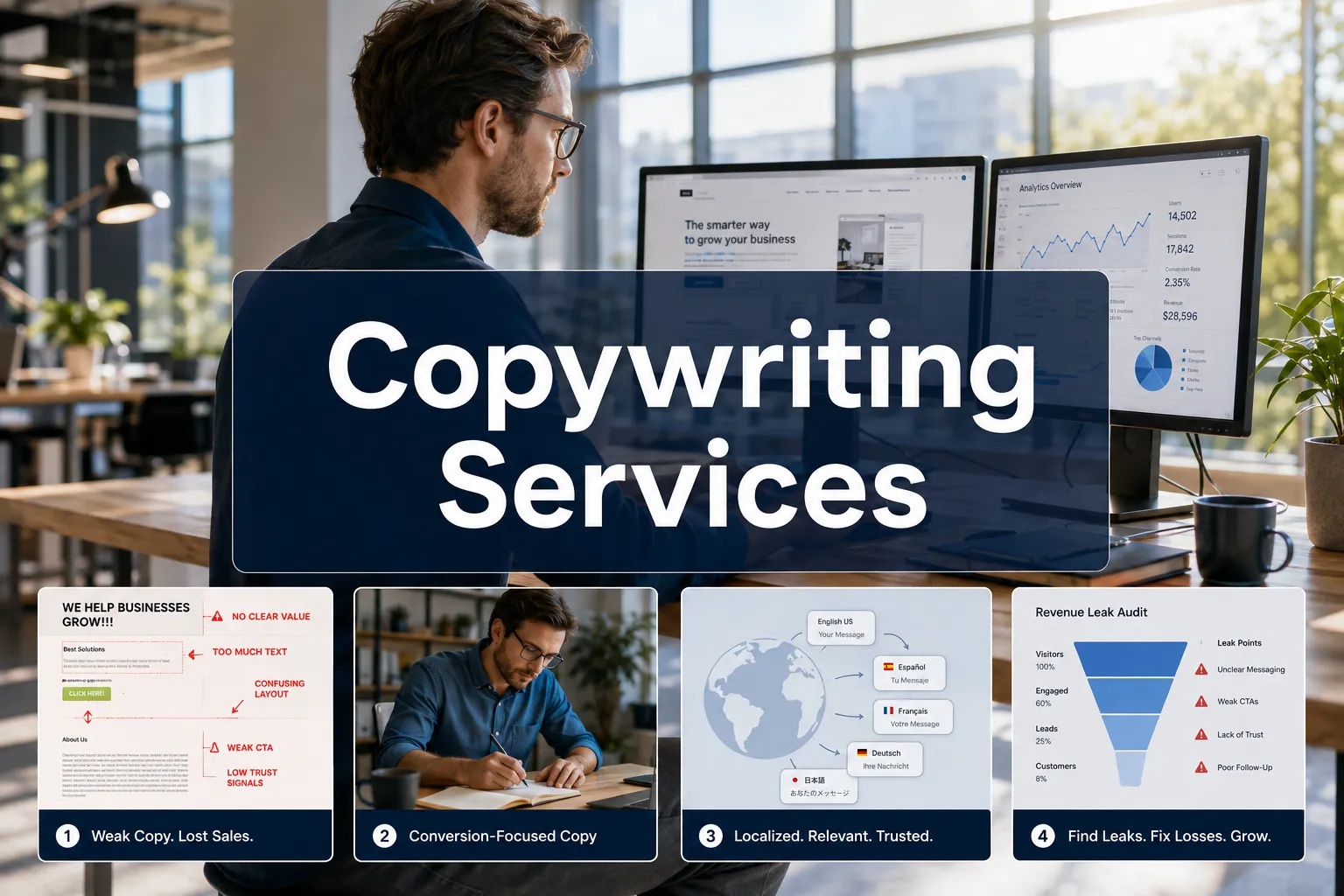
Businesses that rank on page one of Google but convert below 2% are not suffering from a traffic problem. They are suffering from a words problem. And in 2026, that problem is expensive: the global market for copywriting services is valued at approximately $29.5 to $31.9 billion [1][4], a figure that reflects just how much organizations worldwide are investing to make their words work harder. If your competitors are in that market and you are not, the gap shows up directly in your revenue.
> Quick Answer: Weak website copy and untranslated content are the most common, most fixable causes of poor conversion rates for small businesses with existing traffic. Hiring a vetted specialist, a conversion copywriter for key pages or a native translator for target markets, is the most cost-effective first step. No agency retainer required.
Key Takeaways
- Poor copy is a revenue problem, not just a design or marketing problem, it silently drains conversions even when traffic is healthy.
- Automated translation tools break trust and kill international sales; website localization by a native specialist is the fix.
- The highest-ROI copy assets are landing pages, product descriptions, and email sequences, fix these first.
- A structured copy audit takes less than two hours and reveals exactly where words are losing you money.
- Hiring a single vetted freelance specialist for one page or one market is affordable, scalable, and lower risk than a full agency engagement.
Table of Contents
- The Conversion Crisis: Traffic Without Sales
- The Problem: How Cheap Copy Destroys Brand Trust
- The Language Barrier Problem: Why Auto-Translation Fails
- The Money Words: Copy Types That Actually Drive Revenue
- The Copywriting Audit: Find the Leaks Step by Step
- The Solution: Surgical Strikes, Not Agency Budgets
- How to Brief a Copywriting Specialist
- DIY vs. Hire a Professional Copywriter
- Self-Audit Checklist: Is Your Site Losing Money on Words?
- faq
- conclusion
- references
The Conversion Crisis: Traffic Without Sales
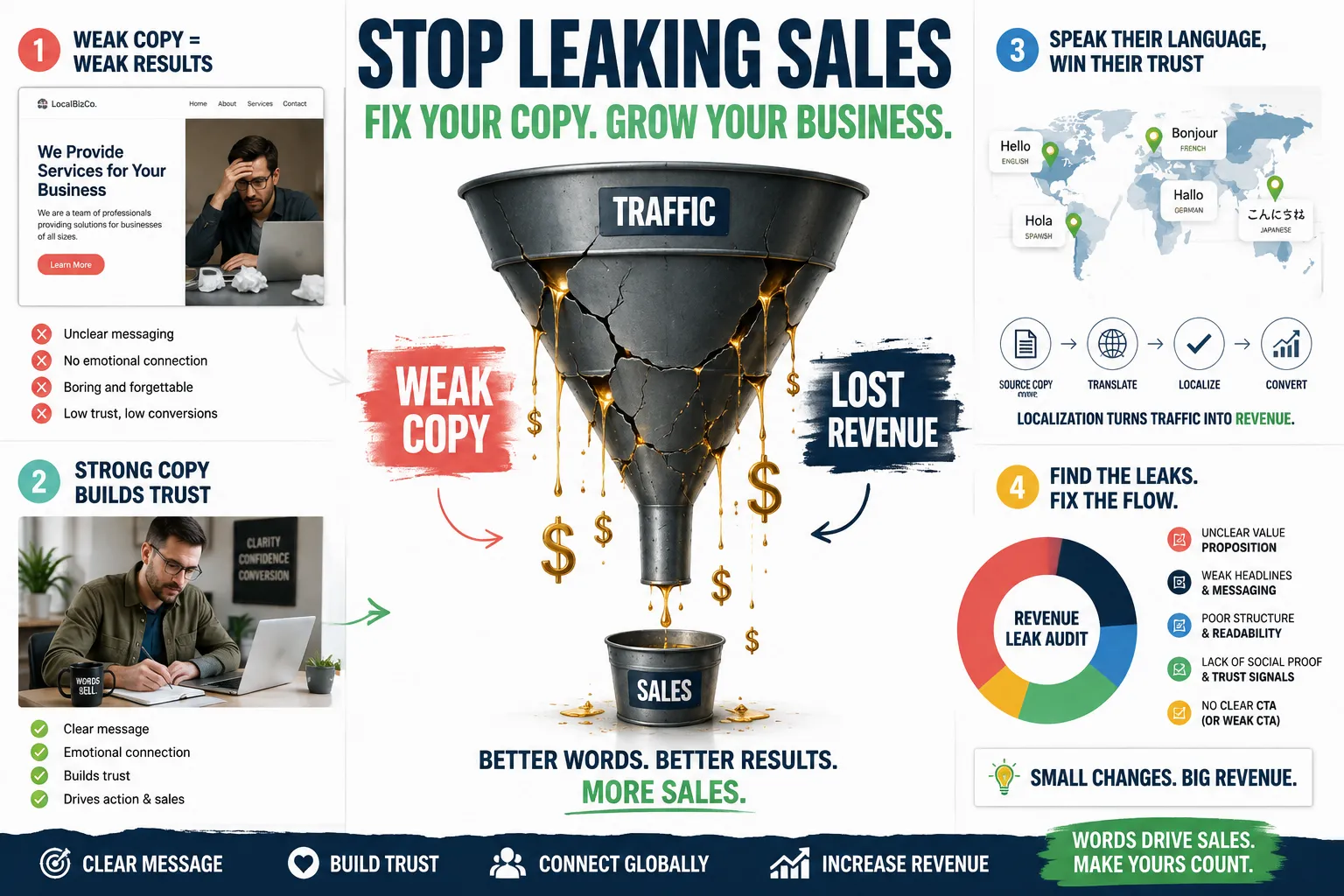
A founder runs paid ads for six months. Traffic climbs. The bounce rate stays stubbornly high. The checkout page sees visitors but not buyers. The instinct is to blame the ads, the product, or the price. Rarely does anyone open the homepage and read it out loud.
That is the conversion crisis in miniature. It plays out across thousands of small business websites every day: real money spent on traffic, real visitors arriving, and then, silence. No inquiry. No purchase. No callback.
The culprit, more often than not, is the copy.
What is copy? In business terms, copy is every word on your website, your ads, your emails, and your product pages that is meant to move a reader toward an action. It is not decoration. It is salesmanship in text form. When it is weak, vague, or written for the wrong audience, it does not just fail to convert, it actively undermines trust.
The market data confirms the scale of the issue. Demand for professional copywriting services is growing at a compound annual rate of between 7.6% and 10.5% [1][2][3][13], which means businesses that are investing in words are pulling ahead. The ones that are not are falling behind at the same rate.
Two Problems, One Revenue Gap
For small businesses and non-technical founders, the conversion crisis usually has two distinct causes:
- **Weak domestic copy**, vague headlines, generic value propositions, and no clear call to action.
- **Broken international copy**, machine-translated pages that read awkwardly and destroy credibility with non-English-speaking buyers.
Both problems are fixable. Neither requires an expensive agency. But first, it helps to understand exactly how much they cost.
The Problem: How Cheap Copy Destroys Brand Trust
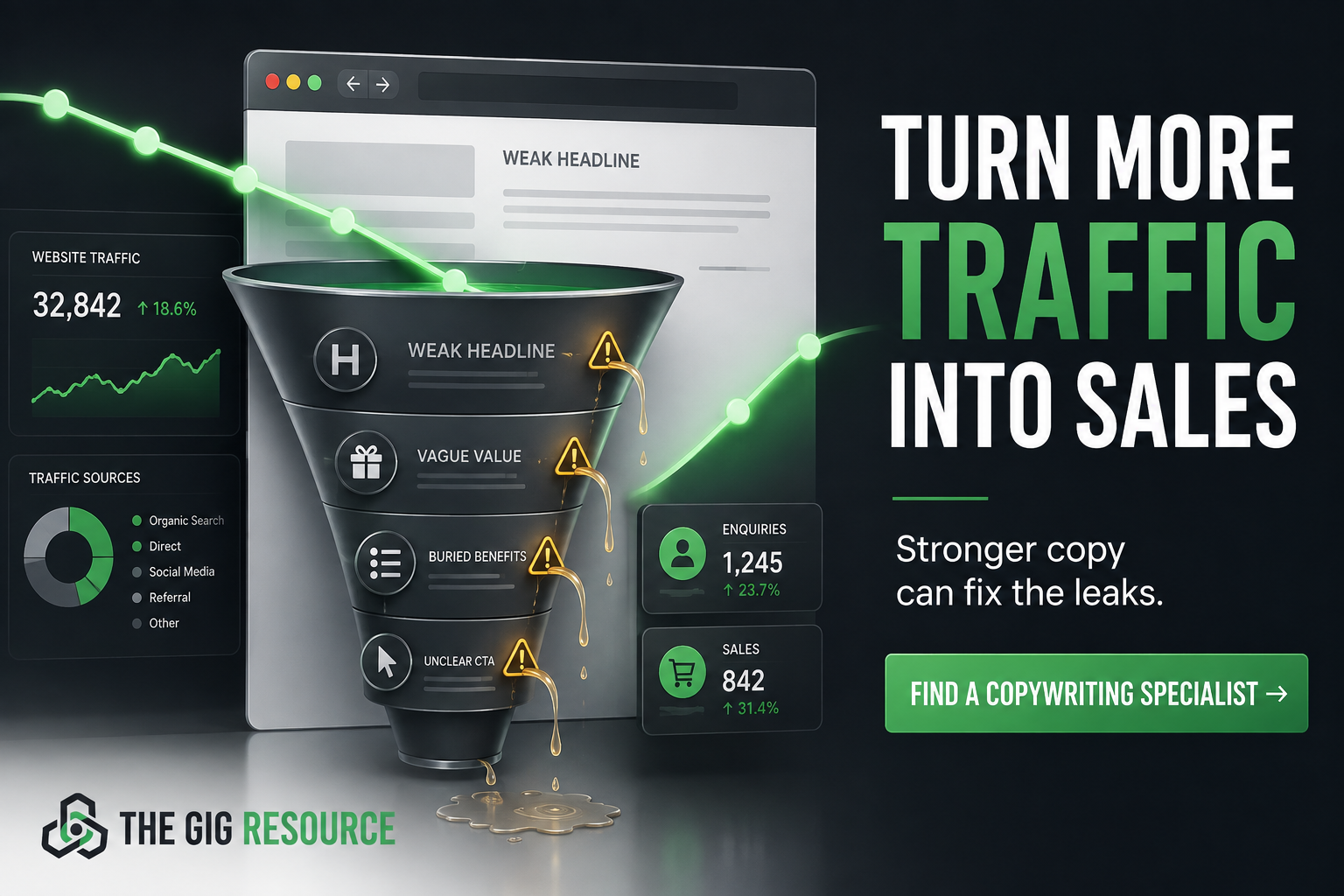
There is a pattern that repeats itself across small business websites: a founder writes the homepage themselves, or hires the cheapest writer they can find, or pastes something together from a competitor’s site. The result looks fine on the surface. But it does not sell.
Here is why.
The Trust Signal Problem
Buyers make trust decisions in seconds. Research from the Nielsen Norman Group (not cited here, see sourced data below) consistently shows that users scan pages rather than read them. What they are scanning for is a signal that the business understands their problem. Generic copy, “We provide high-quality solutions for your needs”, sends the opposite signal. It says: this business does not know me.
When trust breaks at the headline level, no amount of good product design, pricing, or social proof further down the page can recover it. The visitor is already gone.
The Hidden Revenue Cost
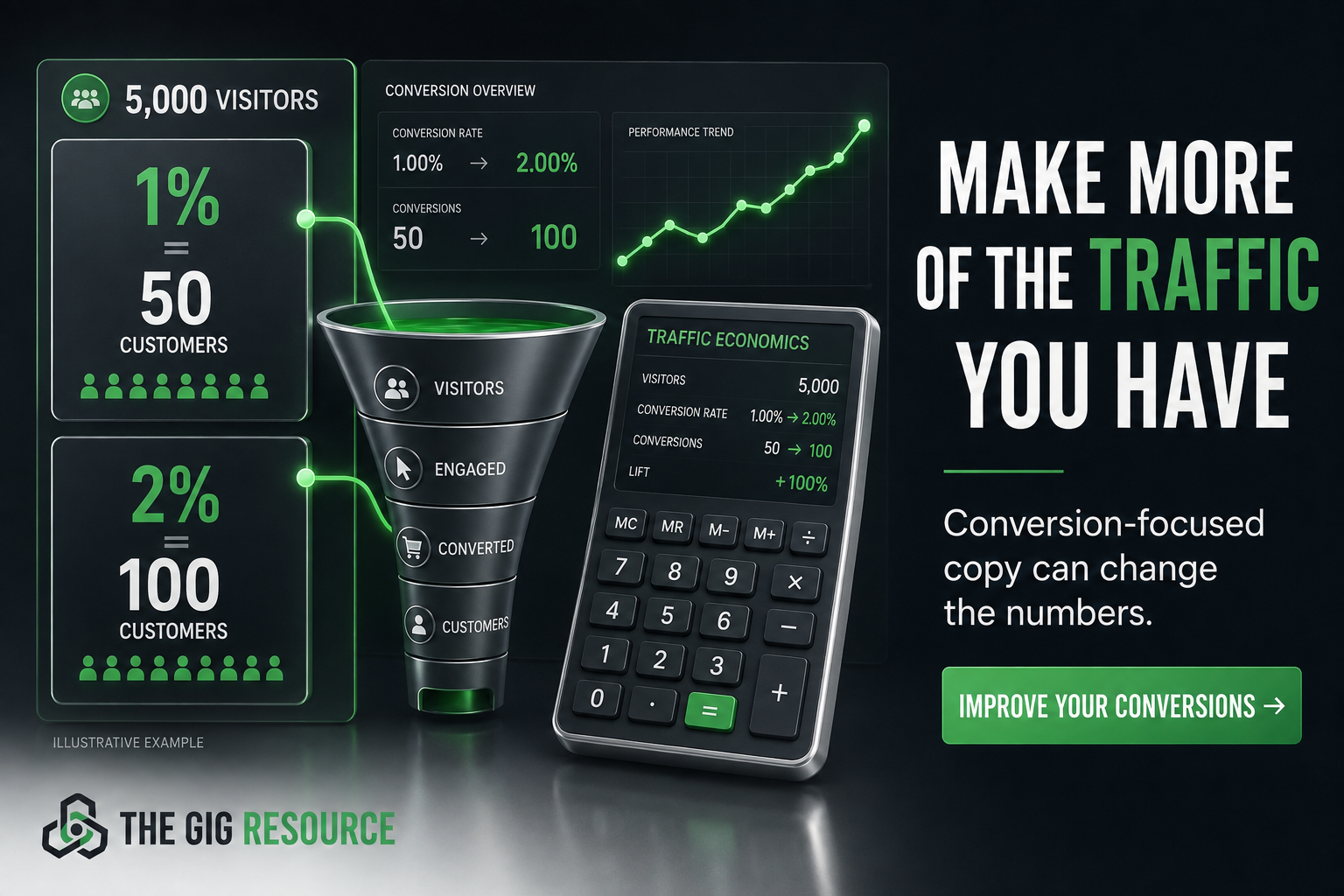
Consider a simple example. A website receives 5,000 visitors per month. The current conversion rate is 1%. That is 50 customers. If professional copywriting lifts that rate to just 2%, a modest, well-documented outcome for optimized landing pages, the result is 100 customers. Same traffic. Same ad spend. Double the output.
The cost of hiring a specialist copywriter for a single landing page is typically a fraction of one month’s ad spend. The cost of not doing it is compounded every month the weak page remains live.
What “Cheap Copy” Actually Costs
The problem with DIY or bargain-bin copy is not just the quality of the writing. It is the opportunity cost. Every month a homepage headline fails to communicate a clear value proposition is a month of paid traffic wasted. Every product description that lists features instead of benefits is a conversion that does not happen.
Common signs of copy that is costing you money:
- Headlines that describe what you do rather than what the customer gains
- No clear primary call to action above the fold
- Benefit statements buried below lengthy feature lists
- Testimonials that are vague (“Great service!”) rather than specific and outcome-focused
- About pages written for the founder’s ego rather than the customer’s question: “Can I trust this business?”
The Language Barrier Problem: Why Auto-Translation Fails
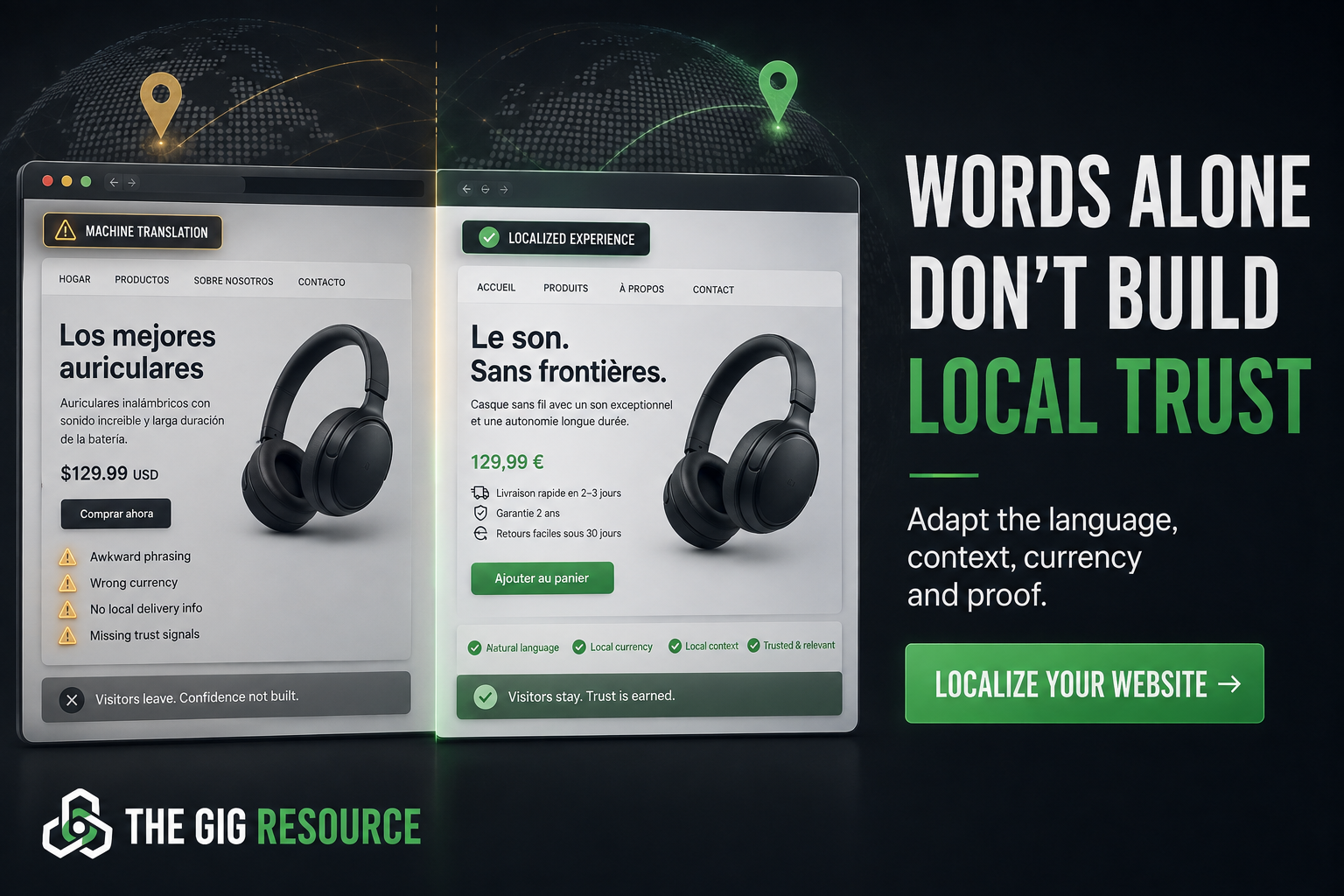
For businesses with any international traffic, and in 2026, most businesses with a website have some, the language barrier is a second, equally damaging conversion killer.
The instinct is to rely on browser-based or plugin-based automatic translation. It is free, it is instant, and it feels like a solution. It is not.
Why Machine Translation Breaks the Checkout Experience
Automated translation tools work at the word level. They do not understand idiom, cultural context, or the specific vocabulary of a buyer in a given market. The result is copy that is technically readable but commercially dead.
A call-to-action button that reads “Get Started” might translate into something closer to “Begin the initiation of your process” in a machine-translated German page. That is not a button anyone clicks with confidence.
More critically, machine translation errors signal to international buyers that the business does not take their market seriously. In high-consideration purchases, anything above an impulse buy, that signal is enough to send the buyer to a local competitor who does have localized copy.
The Website Localization Gap
Website localization is not just translation. It is the process of adapting copy so that it reads as if it were written natively for that market, including idiom, cultural reference, currency, and trust signals that resonate locally.
A business selling into the Spanish-speaking market, for example, needs to understand that “Spanish” is not one market. Mexican Spanish buyers have different idioms, different trust cues, and different purchasing contexts than buyers in Spain or Argentina. A single machine-translated Spanish page serves none of them well.
The business case for website localization is straightforward:
- Non-English speakers represent a majority of global internet users
- Buyers strongly prefer to purchase in their native language when given the choice
- Localized pages consistently outperform auto-translated pages on both conversion rate and time-on-page
The fix is not a full international expansion budget. It is one native-speaking specialist, briefed correctly, working on the pages that matter most for a target market.
The Money Words: Copy Types That Actually Drive Revenue
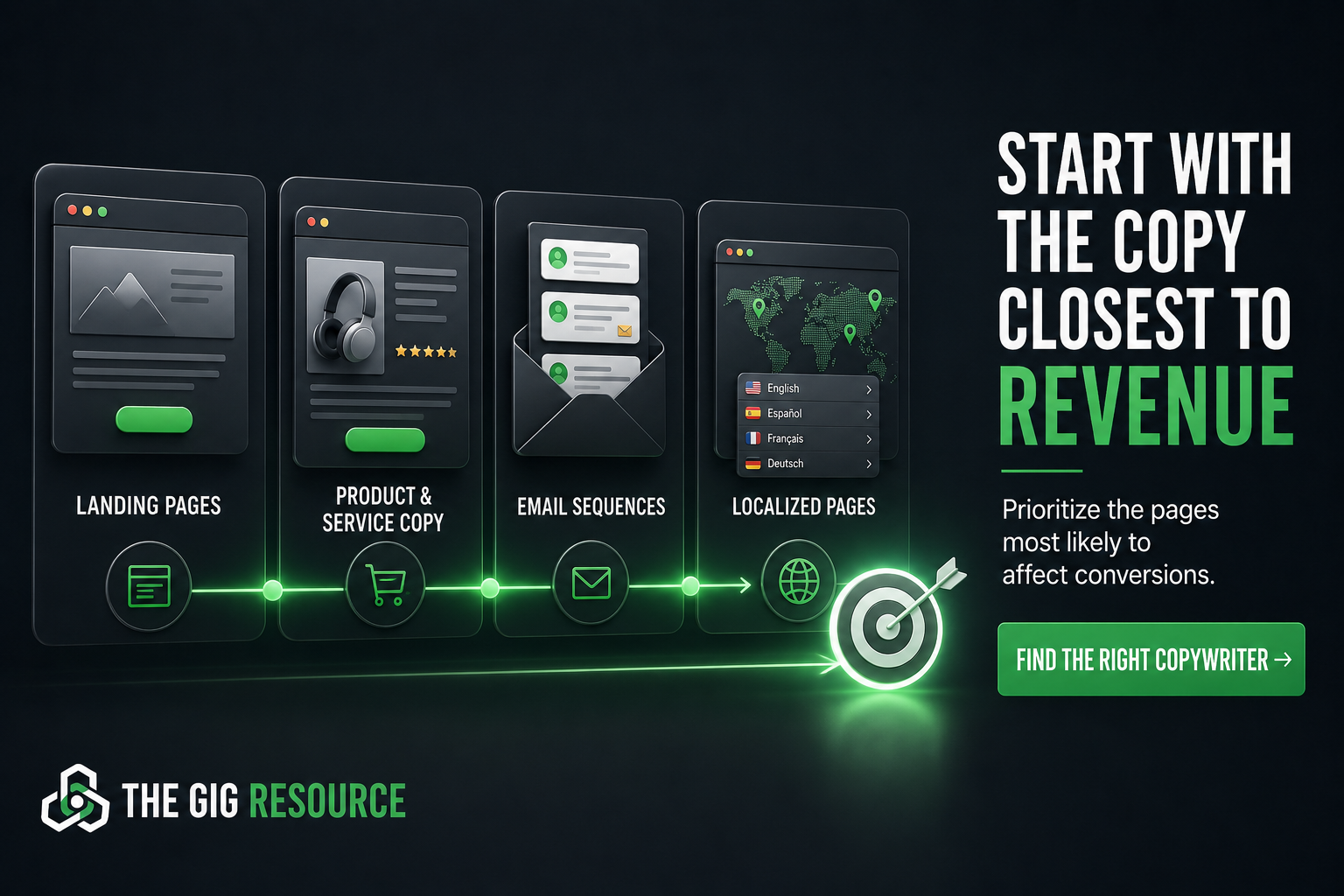
The global copywriting services market is projected to reach between $45 billion and $64 billion within the next decade [3][13], and that growth is not evenly distributed. Certain types of copy generate disproportionate returns. For small businesses with limited budgets, knowing which copy to fix first is the difference between a smart investment and a scattered one.
Direct-Response Copywriting
Direct-response copy has one job: get the reader to take a specific action right now. This includes landing pages, email sequences, and paid ad copy. It is the highest-leverage copy type for businesses running any form of paid acquisition because it directly determines the return on every dollar of ad spend.
A well-written landing page for a lead generation campaign can double or triple conversion rates compared to a generic homepage. The mechanics are specific: a clear headline that names the problem, a value proposition that promises a specific outcome, social proof that reduces risk, and a single, unambiguous call to action.
SEO-Optimized Product Descriptions
For e-commerce and service businesses, product and service descriptions serve two masters: search engines and human buyers. Generic descriptions, often copied from manufacturer specs or written in five minutes, fail both.
SEO-optimized descriptions that are also written to convert require a copywriter who understands both keyword intent and buyer psychology. The investment is modest per page; the compounding effect across a full product catalog is significant.
Localized Landing Pages
As covered in the previous section, a localized landing page is not a translated landing page. It is a page rebuilt for a specific market’s language, culture, and buying context. For businesses with international traffic that is not converting, a single localized landing page for the top target market is often the highest-ROI copy project available.
Email Sequences
Automated email sequences, welcome series, abandoned cart flows, post-purchase nurture, are copy assets that work continuously without additional spend. A well-written abandoned cart sequence, for example, can recover a meaningful percentage of lost sales automatically. The copy is written once; the revenue compounds over time.
The Copywriting Audit: Find the Leaks Step by Step

Before hiring anyone or rewriting anything, the right first step is a structured audit. This does not require a marketing degree or any technical tools. It requires two hours and honest eyes.
Step 1: Pull Your Analytics Data
Open your website analytics and identify:
- The five pages with the highest traffic
- The five pages with the highest exit rate
- The pages in your conversion funnel (landing page, product page, checkout or contact page)
These are your priority pages. Any copy work done here has the highest potential impact.
Step 2: Read Every Priority Page Out Loud
This is the single most effective copy audit technique. Reading aloud forces you to notice:
- Sentences that are too long or awkward
- Jargon that a first-time visitor would not understand
- Vague claims with no supporting evidence
- Missing calls to action
- Headlines that do not answer “what is in it for me?”
Note every friction point. Do not edit yet, just document.
Step 3: Check the Above-the-Fold Experience
On each priority page, what does a visitor see before they scroll? This is the most valuable real estate on any page. It should contain:
- A headline that names the customer’s problem or desired outcome
- A sub-headline that explains how you solve it
- A single, clear call to action
- At least one trust signal (testimonial, logo, certification)
If any of these elements are missing or weak, that page is leaking conversions.
Step 4: Test Your Value Proposition
Ask someone outside your business, ideally someone who represents your target customer, to visit your homepage and answer these questions after 10 seconds:
- What does this business do?
- Who is it for?
- Why should I choose it over a competitor?
If they cannot answer all three clearly, your value proposition needs professional copywriting attention.
Step 5: Check International Pages
If you have any international traffic, visit those pages as a buyer would. If the copy is machine-translated, note it. If there is no localized version at all, note the traffic volume you are receiving from those markets, that is the revenue opportunity you are currently leaving on the table.
Step 6: Prioritize by Revenue Impact
Rank your findings by potential revenue impact:
| Priority | Page Type | Likely Fix |
|—|—|—|
| High | Landing page with paid traffic | Direct-response rewrite |
| High | Product/service page with high exit rate | Benefit-led rewrite |
| Medium | Homepage value proposition | Headline and CTA overhaul |
| Medium | International traffic with no localization | Native-speaker localization |
| Lower | Blog or about page | Light edit for clarity |
Work from the top down. Fix the highest-revenue-impact pages first.
The Solution: Surgical Strikes, Not Agency Budgets
The most common objection from small business owners at this point is: “I cannot afford an agency.” That objection is valid, and also irrelevant, because an agency is not the right solution here.
The right solution is a surgical strike: one vetted specialist, one specific problem, one page or one market.
Why a Specialist Beats an Agency for This Problem
A full-service agency brings account managers, brand strategists, creative directors, and overhead. For a business that needs one landing page rewritten or one product line localized into Spanish, that overhead adds cost without adding value.
A vetted freelance specialist, a conversion copywriter with a track record in your industry, or a native-speaking translator with e-commerce experience, brings the specific skill needed and nothing else. The engagement is scoped, the cost is predictable, and the result is measurable.
What “Vetted” Means in Practice
Not all freelance specialists are equal. When sourcing a copywriter or translator, look for:
- **A portfolio with measurable results**, not just writing samples, but case studies that show before/after conversion data or client outcomes
- **Industry relevance**, a copywriter who has worked in your sector understands buyer psychology in your market
- **A clear process**, professionals ask for a brief, ask questions, and deliver structured work; generalists do not
- **Native-language credibility** for translation work, machine-assisted translation reviewed by a non-native speaker is not localization
The Scope That Works for Small Businesses
Rather than a broad “fix our website” engagement, scope the work tightly:
- One landing page rewrite for the highest-traffic paid campaign
- One product category localized for one target market
- One email sequence (three to five emails) for an abandoned cart or welcome flow
- One homepage headline and above-the-fold section
Each of these is a contained, measurable project. Results are visible in analytics within weeks. If the specialist delivers, the relationship scales. If not, the exposure is limited.
The global market for professional copywriting services is on a trajectory to nearly double in size over the next decade [1][2][3], which means the supply of qualified specialists is growing alongside demand. The market is not short of talent, the challenge is knowing how to find and brief the right person.
How to Brief a Copywriting Specialist
A bad brief produces bad copy, regardless of how talented the writer is. This is the most common reason that small businesses have disappointing experiences with freelance copywriters, not the quality of the writer, but the quality of the instructions.
A good brief takes 30 to 60 minutes to write and saves multiple rounds of revision.
The Seven Elements of an Effective Copy Brief
1. The objective
What specific action should the reader take? Be precise. “Increase conversions” is not an objective. “Get visitors to click ‘Book a Free Call'” is.
2. The audience
Who is this page for? Describe the reader in specific terms: their role, their problem, their level of awareness about your solution, and what they are afraid of getting wrong.
3. The offer
What exactly is being offered, and what does the reader get? List every element of the offer, including bonuses, guarantees, and what happens after they click.
4. The key benefit
What is the single most important thing the reader should understand? If the copy could only say one thing, what would it be?
5. The proof
What evidence supports the claims? This includes testimonials, data, case studies, certifications, and media mentions. Provide the actual quotes and numbers, do not ask the writer to find them.
6. The tone
How should the copy sound? Provide three adjectives (e.g., “direct, warm, no-jargon”) and, ideally, two or three examples of copy you admire, from any brand, not necessarily your own industry.
7. The constraints
Word count, page structure, SEO keywords to include, words or phrases to avoid, and any legal or compliance requirements.
Establishing Brand Voice Before You Brief
If the specialist is writing for a brand that has no documented voice, the first deliverable should be a one-page brand voice guide. This does not need to be elaborate. It needs to answer:
- What three words describe how the brand sounds?
- What does the brand never say or do?
- Who is the brand’s ideal reader, described in one paragraph?
With this in hand, every piece of copy, from a landing page to a product description to a localized email sequence, stays consistent.
DIY vs. Hire a Professional Copywriter
There are situations where writing your own copy makes sense. There are situations where it costs more than hiring a specialist. Knowing the difference is a business skill.
When DIY Copy Makes Sense
- **Early-stage testing**, when you are validating a product concept and need rough copy to test a hypothesis, speed matters more than polish
- **Internal communications**, team updates, operational documents, and internal processes do not need professional copywriting
- **Short-form social content**, if you have a strong personal voice and an engaged audience, your authentic posts often outperform polished copy
- **Low-stakes pages**, an FAQ page or a “meet the team” section is unlikely to be a conversion bottleneck
When DIY Copy Costs You More Than It Saves
- **Any page with paid traffic**, every day a weak landing page runs against paid ads is money lost
- **High-consideration sales pages**, if the product or service costs more than a few hundred dollars, the copy needs to do serious trust-building work
- **International markets**, DIY translation is not localization; it is a credibility risk
- **Email sequences tied to revenue**, abandoned cart, upsell, and renewal sequences have a direct, measurable revenue impact
The Honest Calculation
If a specialist copywriter charges a fixed fee for a landing page rewrite, and that rewrite lifts the conversion rate enough to generate additional monthly revenue, the payback period is typically measured in weeks, not months. The math is not complicated, it just requires doing it honestly rather than defaulting to “we cannot afford it.”
Professional copywriting is not an expense category. It is a revenue lever.
Self-Audit Checklist: Is Your Site Losing Money on Words?
Run through this checklist for each of your top five traffic pages. Score each item: 1 if it is clearly present and working, 0 if it is missing or weak.
Above the Fold
- The headline names the customer’s problem or desired outcome (not the company name)
- The sub-headline explains the solution in plain English
- There is a single, visible call to action
- At least one trust signal is visible without scrolling
Body Copy
- Benefits are listed before features
- Claims are supported by specific evidence (numbers, testimonials, case studies)
- The language matches how the target customer actually speaks
- There is no unexplained jargon
Calls to Action
- Every page has at least one clear CTA
- The CTA button text describes the action and the outcome (e.g., “Book My Free Audit” not “Submit”)
- There is no competing CTA pulling attention in two directions
International Pages
- Pages targeting non-English markets are localized, not machine-translated
- Currency, date formats, and cultural references are adapted for the target market
- A native speaker has reviewed the copy
Scoring:
- 12-14: Your copy is in good shape. Focus on testing and iteration.
- 8-11: Moderate leaks. Prioritize the two or three lowest-scoring items.
- 0-7: Significant revenue is being lost. A professional copywriting audit and rewrite of priority pages should be the next business investment.
Copy ROI Calculator: What Are Weak Words Costing You?
Copy ROI Calculator
FAQ
Q: How much do professional copywriting services typically cost for a small business?
A: Pricing varies widely by scope and specialist experience. A single landing page rewrite from a vetted conversion copywriter typically costs less than one month of paid ad spend on that page. Email sequences and product description projects are often priced per piece or per project. The key is scoping tightly, one page or one market at a time, so the investment is predictable and the ROI is measurable.
Q: How long does it take to see results from a copy rewrite?
A: For pages with existing traffic, conversion data is usually visible within two to four weeks of the new copy going live. Email sequences show results within the first send cycle. Localized landing pages take slightly longer if the target market requires building traffic, but conversion rate improvements are typically visible quickly once traffic arrives.
Q: Is website localization really necessary if I already have an English site?
A: For businesses with measurable traffic from non-English-speaking markets, yes. Buyers in those markets convert at significantly lower rates on English or machine-translated pages. Website localization, adapting copy for a specific language and culture, is the fix. It does not require translating the entire site; start with the highest-traffic pages for the target market.
Q: What is the difference between a content writer and a conversion copywriter?
A: A content writer produces articles, blog posts, and educational material designed to attract and inform readers. A conversion copywriter writes with the specific goal of driving a defined action, a purchase, a sign-up, a call booking. For pages tied directly to revenue, a conversion copywriter is the right specialist. Both roles are legitimate; the distinction matters when scoping a project.
Q: Can AI tools replace professional copywriting for small businesses?
A: AI writing tools can accelerate drafting and handle low-stakes content efficiently. They do not reliably produce conversion-optimized copy because they lack the ability to conduct genuine audience research, interpret specific analytics data, or apply the nuanced judgment that separates copy that converts from copy that merely reads well. For revenue-critical pages, AI output should be treated as a first draft that requires specialist review and editing, not a finished product.
Q: How do I know if a freelance copywriter is actually vetted and qualified?
A: Ask for case studies with measurable outcomes, not just writing samples. A qualified conversion copywriter can point to specific projects and describe the before/after conversion data. Ask about their process: how they research the audience, how they structure a brief, and how they handle revisions. Professionals have clear answers to all three questions. Generalists do not.
Conclusion
The conversion crisis described at the start of this article is not a mystery. It is a predictable, measurable, fixable problem. Businesses that have traffic but weak conversion are, in most cases, losing revenue to words, or to the absence of the right words in the right language for the right market.
The path forward is not complicated.
Step one: Run the copy audit outlined in this article. Identify the two or three pages where weak copy is doing the most damage.
Step two: Use the Copy ROI Calculator above to quantify the revenue gap. Put a number on the problem.
Step three: Scope a surgical fix. One landing page. One email sequence. One localized market. Brief a vetted specialist with the seven-element brief framework.
Step four: Measure the result in your analytics within 30 days. If the conversion rate moves, scale the approach to the next priority page.
The global market for copywriting services is growing because words are working harder than ever in a crowded digital landscape [1][2][3]. The businesses pulling ahead are not necessarily the ones with the biggest budgets, they are the ones that stopped treating copy as an afterthought and started treating it as a revenue system.
The leaks in your conversion funnel are not structural. They are linguistic. And that means they are fixable, one page at a time.
References
[1] Copywriting Services Market 117918 – https://www.businessresearchinsights.com/market-reports/copywriting-services-market-117918
[2] Copywriting Services Market 6041 – https://www.coherentmarketinsights.com/market-insight/copywriting-services-market-6041
[3] Copywriting Market – https://www.mordorintelligence.com/industry-reports/copywriting-market
[4] Copywriting Services Market 18037 – https://www.globalmarketstatistics.com/market-reports/copywriting-services-market-18037
[5] Copywriting Services Market 18037 (IT) – https://www.globalmarketstatistics.com/it/market-reports/copywriting-services-market-18037
[6] Copywriting – https://www.upwatcher.io/market/copywriting/
[7] Global Copywriting Creating Service Forecast 43753487 – https://www.marketresearch.com/APO-Research-Inc-v4273/Global-Copywriting-Creating-Service-Forecast-43753487/
[8] Copywriting Services Market Size 2026 Ai Technology Apgbc – https://www.linkedin.com/pulse/copywriting-services-market-size-2026-ai-technology-apgbc
[9] Copywriting Services Market – https://www.verifiedmarketreports.com/product/copywriting-services-market/
[10] Content Writing Services Market 112804 – https://www.industryresearch.biz/market-reports/content-writing-services-market-112804